




The Cosmic Speed Limit
Everything in the universe, including light, has a speed limit. Light travels through the vacuum of space at an astonishing 2,99,792 kilometres per second. While that seems instantaneous to us in our daily lives, space is incomprehensibly vast. This finite
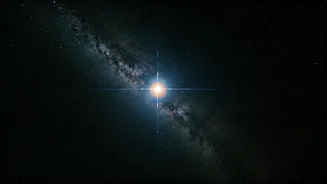
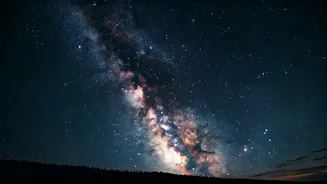
speed means that it takes time—sometimes a very, very long time—for the light from distant objects to reach our eyes here on Earth. Think of it like a cosmic courier service: the message (light) is incredibly fast, but the distance it has to cover is enormous. So, when we look at a star, we aren't seeing it as it is right now. We are seeing it as it was when the light first left its surface.
A Tape Measure Made of Light
To measure these immense distances, astronomers use a unit called a 'light-year'. It’s a common point of confusion, but a light-year is a measure of distance, not time. It's the distance that light travels in one year, which is about 9.5 trillion kilometres. So, if a star is 10 light-years away, it means the light we see from it tonight started its journey 10 years ago. This simple but profound fact transforms our view of the night sky from a static picture into a dynamic history book. Our own Sun is about 8.3 light-minutes away, meaning if it were to suddenly vanish, we wouldn't know about it for over eight minutes.
Your Window into History
The headline’s mention of 'centuries' is beautifully illustrated by Polaris, the North Star. Located approximately 433 light-years away, the light we see from Polaris tonight left the star around the year 1591. At that time in India, the Mughal Empire was flourishing under Emperor Akbar. The world was a completely different place. Every time you locate Polaris in the sky, you are receiving photons that began their journey across the cosmos during a different historical era. Another famous star, Betelgeuse in the Orion constellation, is about 640 light-years away. The light we see from it is a snapshot from the 14th century, a time of great change and turmoil across the world.
Peering at Stars That Might Be Gone
This time-lag effect has a mind-bending implication: we could be looking at stars that no longer exist. A massive star might have exploded in a supernova thousands of years ago, but if it's more than a few thousand light-years away, its 'last light' from before the explosion is still travelling towards us. To any observers closer to that star, it has long since vanished, but for us, it continues to shine brightly in our sky. Astronomers believe Betelgeuse is a candidate for such a future explosion. It could have already exploded, and we just haven't received the news yet. For now, it remains a familiar point of light, a ghost from the past.
Beyond Stars to Ancient Galaxies
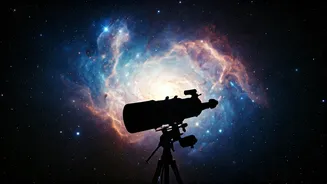
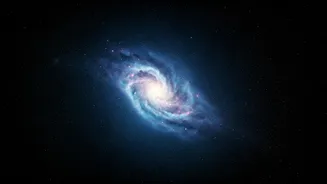
This cosmic time travel doesn't stop at stars within our own galaxy. When we look at the Andromeda Galaxy, the closest major galaxy to our Milky Way, we are seeing it as it was 2.5 million years ago. Its light began its journey when early human ancestors, like Australopithecus, were roaming Africa. The most distant galaxies observed by telescopes like the James Webb Space Telescope are seen as they were over 13 billion years in the past, just a few hundred million years after the Big Bang. By looking farther out into space, astronomers are literally peering into the universe’s infancy, gathering clues about how everything we know came to be.