






The End of the Endless Scroll
Imagine this: a crucial market analysis report lands in your inbox on Monday morning. It’s 45 pages long, packed with tables, charts, and dense paragraphs. Your meeting to discuss it is in two hours. Previously, your only options were to speed-read, miss
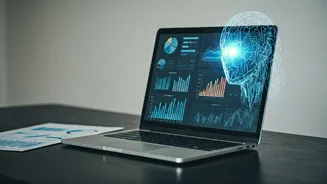
crucial details, or postpone. Today, a third option is emerging. Workspace AI assistants, integrated directly into tools like Microsoft 365, Google Workspace, and Slack, are being designed to act as your personal data analyst. Their goal is to ingest long-form, unstructured information—like that dreaded report—and distill it into its most essential, actionable components. This isn't just about creating a summary; it's about translating walls of text into intuitive, visual dashboards with key performance indicators (KPIs), trend lines, and executive takeaways.
How AI Reads Between the Lines
So, how does this digital magic actually happen? It’s a multi-step process powered by advances in Large Language Models (LLMs) and Natural Language Processing (NLP). First, the AI assistant 'reads' the entire document, whether it’s a Word file, PDF, or even a transcript of a meeting. It uses NLP to understand context, identify entities (like names, dates, and financial figures), and recognise the relationships between them. Next, it performs a form of semantic analysis to pinpoint the most important information—identifying key findings, conclusions, and data points cited as evidence. Finally, it uses generative AI capabilities to synthesise this information into a new format. You might ask it, “Create a one-slide PowerPoint summary of this report, including the top three risks and the projected revenue growth,” and tools like Microsoft’s Copilot will generate the slide for you, complete with bullet points and even a suggested chart.
A Leap in Productivity and Access
The primary benefit is a massive time-saver. Professionals across India and the world spend countless hours sifting through information to find the insights they need to make decisions. Automating this initial analysis frees them up to focus on higher-value tasks: strategy, interpretation, and action. But the second, more profound benefit is the democratisation of data. Not everyone is a trained data analyst who is comfortable navigating complex spreadsheets or statistical reports. By transforming this data into a simple dashboard, AI assistants make critical business information accessible to a much wider audience, from sales managers to marketing leads. This allows for more data-informed decisions to be made faster and at all levels of an organisation, fostering a more agile and responsive business culture.
The Risk of the 'Confident But Wrong' AI
However, this powerful new capability comes with significant risks that cannot be ignored. The biggest danger is the AI 'hallucination'—where the model generates information that is plausible-sounding but factually incorrect. A dashboard that looks professionally made but is based on a misinterpreted statistic could lead to disastrous business decisions. Furthermore, over-simplification can be a problem. Nuance, context, and the 'story behind the data' are often lost when a complex report is flattened into a few bullet points and charts. The principle of 'garbage in, garbage out' still applies; if the source report is flawed, the AI-generated dashboard will be too. This makes human oversight not just important, but absolutely essential. These tools should be seen as a first draft, not the final word.
The New Skill Set for the Indian Professional
For the Indian workforce, which has rapidly embraced digital transformation, this trend marks the next evolution in workplace skills. The future doesn't belong to the person who can read the fastest, but to the person who can ask the AI the smartest questions. Prompt engineering—the art of crafting clear, specific instructions for an AI—is becoming a critical skill. More importantly, professionals will need to cultivate their critical thinking and analytical validation skills. Instead of just consuming the dashboard, the valuable employee will be the one who asks: “Where did the AI get this number? What context might be missing? Does this align with what we know about our market?” The ability to partner with AI, using its speed while checking its work with human wisdom, will define the next generation of effective leaders and knowledge workers.