




1. Shoulder Rolls
This is the classic move for releasing tension in the shoulders and upper back. Sitting for hours causes shoulders to round forward and creep up toward the ears, creating knots and stiffness. Shoulder rolls counteract this by moving the shoulder blades
through their full range of motion. Sit up tall with your feet flat on the floor and your arms relaxed by your sides. Inhale as you lift your shoulders straight up toward your ears. Exhale as you roll them back, squeezing your shoulder blades together gently, and then let them drop down and relax. Perform 10 slow, fluid circles backward, then reverse the direction and roll them forward 10 times. The key is to make the movement smooth and continuous, not a jerky shrug.
2. Neck Tilts
Staring at a screen often leads to 'tech neck', where your head drifts forward, straining the muscles at the back and sides of your neck. Gentle neck tilts help stretch these tight muscles, particularly the upper trapezius which runs from your neck to your shoulder. While sitting straight, slowly tilt your right ear toward your right shoulder until you feel a gentle stretch on the left side of your neck. Don't force it or pull with your hand. Hold for 15 to 30 seconds, breathing deeply. Return to the center and repeat on the other side. Do this two to three times for each side to effectively release tension.
3. Seated Spinal Twist
Sitting in one position for a long time can make your spine feel rigid. A seated spinal twist helps to gently restore rotation and flexibility to your mid-back (thoracic spine), relieving tension and improving posture. Sit tall on the edge of your chair with your feet flat on the floor. Keeping your hips facing forward, inhale to lengthen your spine. As you exhale, gently twist your upper body to the right, placing your left hand on your right knee and your right hand on the back or arm of the chair for support. Look over your right shoulder if it's comfortable for your neck. Hold for a few deep breaths, then slowly return to the center and repeat on the left side.
4. Chest Opener Stretch
Hunching over a keyboard shortens the muscles in your chest, contributing to rounded shoulders. This stretch does the opposite, opening up the front of your body and encouraging better posture. You can do this while seated or standing. Clasp your hands behind your lower back. Straighten your arms, roll your shoulders back and down, and gently lift your hands away from your body while pushing your chest forward. You should feel a stretch across your chest and the front of your shoulders. Hold for 20 to 30 seconds, release, and repeat a few times throughout the day.
5. Wrist and Finger Stretches
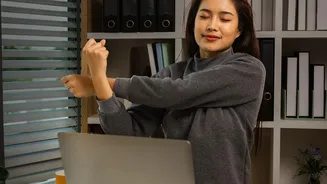
Constant typing and mouse use can lead to strain in your wrists and forearms. These simple stretches can prevent stiffness and improve circulation. First, extend your right arm in front of you with your palm facing up. Gently bend your wrist down, using your left hand to pull your fingers toward the floor until you feel a stretch. Hold for 15-30 seconds. Then, flip your palm to face down and gently pull your fingers toward your body. Repeat on the other side. Finish by making a tight fist with each hand and then spreading your fingers as wide as possible, repeating this 5-10 times.
6. Seated Cat-Cow
Borrowed from yoga, the cat-cow stretch is excellent for improving spinal mobility and relieving back tension. Doing it in a chair makes it accessible for a quick work break. Sit at the edge of your chair with your hands on your knees and feet flat on the floor. As you inhale (Cow pose), arch your back, lift your chest, and look slightly upward, rolling your pelvis forward. As you exhale (Cat pose), round your spine, tuck your chin to your chest, and draw your navel in, letting your back curve. Flow slowly between these two positions for 6 to 8 repetitions, matching the movement to your breath.
7. Seated Figure-Four Stretch
Sitting for long periods can tighten your hips and gluteal muscles, sometimes contributing to lower back pain. The seated figure-four, or chair pigeon pose, specifically targets these deep muscles. While sitting on your chair, cross your right ankle over your left thigh, just above the knee. Keep your right foot flexed to protect the knee. Sit up tall, and if you already feel a stretch in your right hip and glute, stay there. For a deeper stretch, gently hinge forward from your hips, keeping your back straight, until you feel a comfortable stretch. Hold for about 30 seconds, breathing deeply, then switch sides.