


A Universe Set in Stone
To understand the shock of this 'new star', we must first understand the 17th-century cosmos. For centuries, European thought was dominated by the ideas of the ancient Greek philosopher Aristotle. He proposed a geocentric universe where a stationary Earth
sat at the center, surrounded by a series of perfect, crystalline spheres that carried the Moon, Sun, planets, and stars in flawless circles. A fundamental part of this model was the idea of immutability: the heavens beyond the Moon were made of a fifth element, 'aether', and were considered eternal and unchangeable. Change, decay, and new phenomena were believed to be confined to the imperfect, 'sublunary' sphere of Earth. This was not just a scientific model; it was a deeply ingrained philosophical and theological worldview.
A Star Is (Not) Born
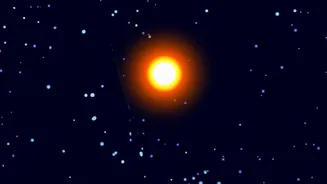
When the supernova first appeared on October 9, 1604, observers across Europe and Asia were captivated. It grew so bright that it was visible during the day for over three weeks. The headline's mention of the 'early telescope-era' is a fascinating point of context. The supernova of 1604 was actually one of the last major astronomical events observed with the naked eye, just a few years before the telescope would permanently alter the science. The first patent for a telescope was filed in the Netherlands in 1608, and Galileo Galilei would not turn his improved versions to the heavens until 1609. Thus, astronomers of 1604 had to rely on traditional instruments and their own eyes.
Kepler's Meticulous Watch
Among the many who studied the phenomenon, German astronomer Johannes Kepler became the most famous. Although he first observed it on October 17 due to cloudy weather in Prague, his detailed and systematic tracking over the next year earned the event its name: Kepler's Supernova. Inspired by Tycho Brahe's work on a similar event in 1572, Kepler set out to determine the new star's true nature. The crucial question was its distance. Using precise instruments, he tried to measure its parallax—the apparent shift in position of an object when viewed from different locations. If the star was close, like a comet within Earth's atmosphere, it would show a noticeable parallax. Kepler, like Galileo and others, found none. This was the critical piece of evidence.
Shattering the Crystal Spheres
The lack of parallax proved the star was not a local atmospheric event but was located far away, in the realm of the supposedly fixed and unchangeable stars. This was a direct and devastating contradiction to the Aristotelian model. How could a 'new' star appear in a perfect, eternal heaven? The event provided powerful ammunition for those, like Galileo, who were beginning to champion the Sun-centered Copernican model. It showed that the heavens were not immutable but dynamic and subject to dramatic change. This philosophical shift was as explosive as the star itself, helping to dismantle a worldview that had stood for nearly two millennia and paving the way for the Scientific Revolution.
The Ghost of 1604
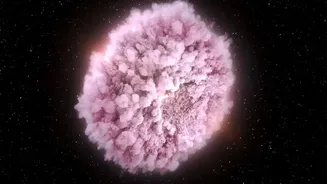
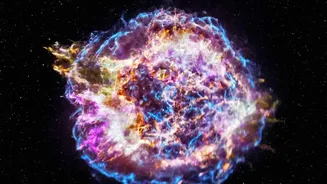
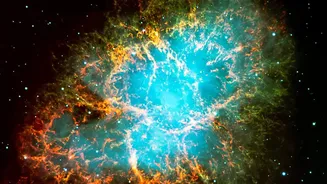
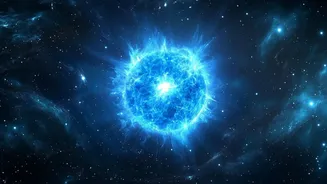
Today, we know that Kepler and his contemporaries were not witnessing the birth of a star, but its spectacular death. SN 1604 was a Type Ia supernova, the thermonuclear explosion of a white dwarf star in a binary system, located about 20,000 light-years from Earth. It remains the most recent supernova to be definitively observed with the naked eye within our own Milky Way galaxy. Modern instruments like the Hubble and Chandra X-ray Observatory have studied the expanding cloud of debris left behind, known as Kepler's Supernova Remnant. These observations help scientists understand the mechanics of these explosions, which are now used as 'standard candles' to measure the expansion of the universe.