








More Than Just Digital Brains
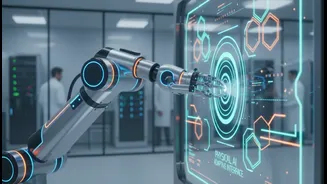
When we hear 'AI', most of us picture chatbots or digital assistants. Physical AI is the next evolution, taking these powerful brains out of the cloud and putting them into the physical world. It refers to systems that can sense their environment, make
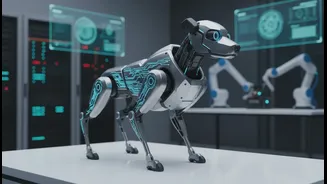
decisions, and perform actions. Think autonomous vehicles, warehouse robots, or surgical assistants. Unlike traditional industrial robots that are programmed for a single, repetitive task, Physical AI systems are designed to be adaptive. They use a suite of sensors like cameras, lidar, and microphones to perceive the world in real-time. This allows them to learn from their surroundings and react to unpredictable situations, much like a human would. The key difference is the shift from rigid automation to true autonomy, where the machine's goal is not just to repeat a movement, but to achieve an objective in a dynamic environment.
A New Standard for Safety
When AI operates in the physical world, the stakes are exponentially higher. A software bug in a chatbot is an annoyance; a bug in a self-driving car or a surgical robot can be catastrophic. This is why safety is the single most important foundation for Physical AI. Companies are developing these systems with safety built-in from the ground up, not as an afterthought. A crucial technique is the use of 'digital twins'—highly realistic virtual simulations of factories, warehouses, or city streets. Robots can be trained and tested in these simulations for thousands of hours, facing countless challenging scenarios without any real-world risk. This rigorous validation ensures that when these machines are deployed, they can navigate complex environments and work safely alongside people, reliably avoiding obstacles and mitigating risks in real time.
Building Trust Through Reliability
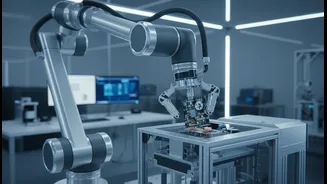
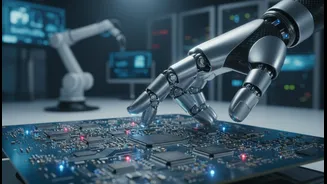
Beyond immediate safety, the long-term success of Physical AI hinges on reliability. For robotics teams and businesses to invest in this technology, they need to trust that it will perform its tasks consistently and accurately, day in and day out. Physical AI achieves this by moving beyond pre-programmed instructions. Using machine learning, these systems continuously improve from experience, refining their actions to become more efficient and precise. This leads to a reduction in human error in critical processes. For example, in manufacturing, AI-powered quality inspection can spot microscopic defects that a human eye might miss. In logistics, autonomous robots can sort and move thousands of packages with near-perfect accuracy, operating 24/7. This level of dependability ensures that operations are not just safer, but also more productive and resilient.
From Warehouses to Hospitals
The applications of Physical AI are already transforming industries across the board. In the massive fulfillment centres that power e-commerce, autonomous mobile robots navigate the aisles to pick, sort, and transport goods. In transportation, companies are developing self-driving cars and delivery drones that promise to make travel safer and logistics more efficient. The medical field is another major beneficiary. Advanced surgical platforms, like the da Vinci system, use robotic arms to assist surgeons in performing minimally invasive procedures with incredible precision. We are also seeing AI-powered drones used in agriculture for precision farming and in utilities for safely inspecting infrastructure like power lines and bridges. Even in our homes, advanced robotic vacuums are a simple form of Physical AI, using sensors to map and navigate our living spaces.
The 'Make in India' Connection
For India, the rise of Physical AI represents a significant opportunity. As routine software and BPO tasks become increasingly automated, the nation's vibrant tech industry is looking towards the next frontier. Physical AI is seen as a major growth area, aligning perfectly with initiatives like 'Make in India'. By integrating intelligent robotics into manufacturing, Indian factories can enhance product quality, improve efficiency, and compete on a global scale. The booming logistics and e-commerce sectors also stand to gain immense value from automated warehouse and delivery systems. Leading Indian IT firms like TCS and HCL, alongside innovative robotics startups such as Addverb and Ati Motors, are already making strides in this domain, developing and deploying Physical AI solutions. This shift is not just about adopting new technology, but about creating a more intelligent, responsive, and robust industrial ecosystem for the future.