



Why Wall Push-Ups Work
Often dismissed as too easy, wall push-ups are a powerful tool for anyone starting a fitness journey or refining their form. They target the same muscles as a standard floor push-up—chest, shoulders, and triceps—but significantly reduce the amount of
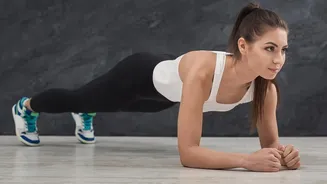
bodyweight you have to lift. This makes them gentler on the joints, particularly the wrists, and allows you to focus on mastering the correct movement pattern without struggling against gravity. By building a solid plank-like posture and controlled motion against the wall, you create the perfect foundation to progress towards more challenging variations.
The Golden Rule of Wall Distance
The principle is simple: the farther your feet are from the wall, the harder the exercise becomes. As you step back, the angle of your body increases, forcing your arms and chest to support more of your body weight. Conversely, moving your feet closer to the wall makes the exercise easier. This makes wall distance the primary way to dial the intensity up or down to match your current strength level. The goal is to find a distance that feels challenging but allows you to maintain perfect form for all your repetitions.
Finding Your Ideal Starting Position
To find your starting point, stand facing a wall, about an arm’s length away. Place your palms flat on the wall, slightly wider than your shoulders and at about chest or shoulder height. Before you begin, create a straight line from your head to your heels. Engage your core by tightening your abdominal muscles and squeezing your glutes to prevent your hips from sagging. Now, bend your elbows and slowly lower your chest towards the wall. If you can complete 10-12 repetitions with controlled form, but the last few feel difficult, you’ve found a good starting distance. If it feels too easy, take a small step back. If your form breaks down, step closer.
How to Progress and Make It Harder
Once you can comfortably perform several sets of 12-15 reps at your current distance, it's time to increase the challenge. This is a core principle of strength training known as progressive overload. The most straightforward way to do this is to take a small step back from the wall, increasing the lean and the load on your muscles. Another method is to slow down your tempo, taking three to five seconds to lower your body toward the wall, which increases the time your muscles are under tension. When wall push-ups at the farthest manageable distance become too easy, you can progress to incline push-ups on a lower, sturdy surface like a countertop or bench, which continues to bridge the gap toward a full floor push-up.
Common Mistakes to Avoid
Your distance from the wall can influence common form errors. If you stand too far back too soon, you might compensate with poor technique. One of the most frequent mistakes is letting your hips sag, which puts stress on the lower back. This can be corrected by consciously bracing your core. Another common fault is flaring your elbows out to the sides in a 'T' shape. This puts unnecessary strain on your shoulder joints. Instead, aim to keep your elbows tucked at roughly a 45-degree angle to your body. Finally, avoid leading with your head or chin. Your body should move as a single, rigid plank from your head to your feet.