




A Hero's First Act: The Ryugu Mission
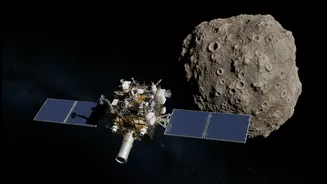
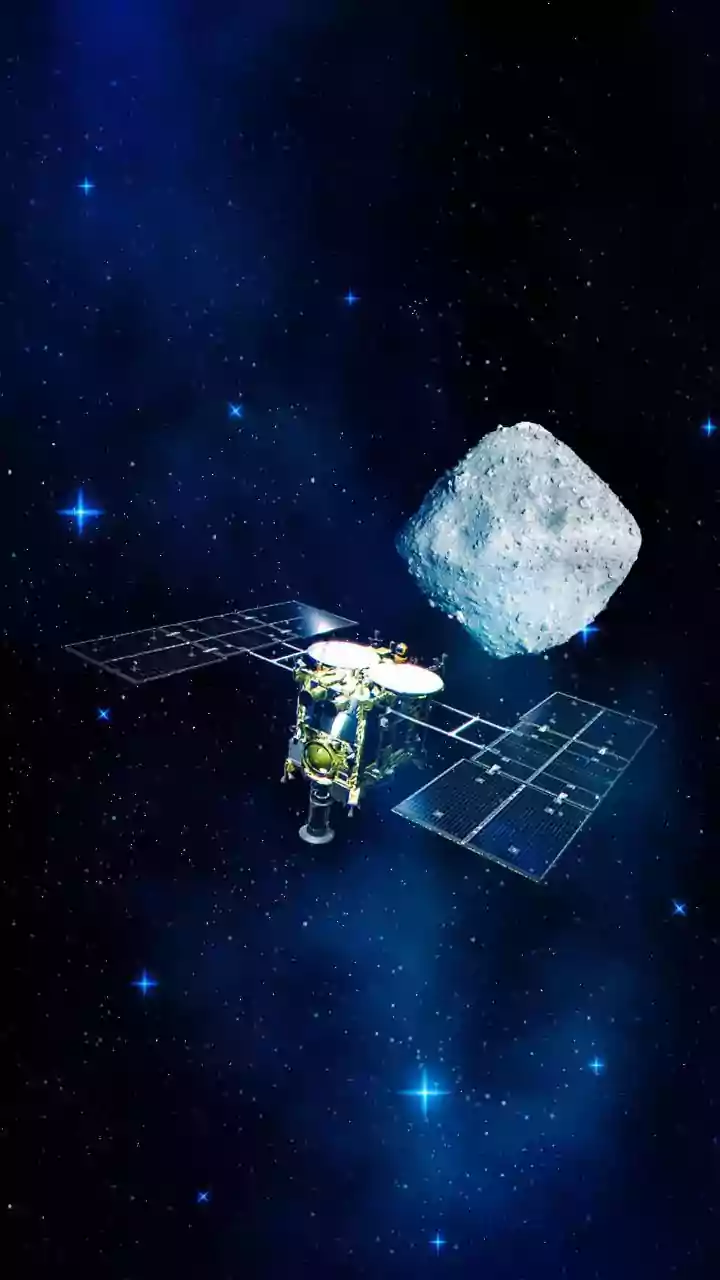
Launched in 2014, Hayabusa2’s primary goal was audacious: travel 300 million kilometres to rendezvous with Ryugu, a carbonaceous near-Earth asteroid. Upon arrival in 2018, it didn't just observe; it deployed multiple rovers and even created an artificial
crater to collect pristine subsurface material. This was a feat of incredible precision. The mission was a resounding success when, in December 2020, a capsule containing precious asteroid dust and rock fragments landed safely in Australia. These samples have given scientists an unprecedented look into the building blocks of our solar system and the potential origins of life.
The Encore: A New Decade-Long Quest
Most missions would end there, but the Japan Aerospace Exploration Agency (JAXA) found that Hayabusa2 was still healthy and had about half of its xenon fuel remaining for its ion engines. This prompted the start of an extended mission, nicknamed Hayabusa2# (pronounced 'sharp'). This new journey is a multi-stage odyssey. In July 2026, the spacecraft performed a high-speed flyby of an asteroid named (98943) Torifune. The ultimate destination, however, is a rendezvous in July 2031 with a tiny, fast-spinning asteroid called 1998 KY26. This target is only about 30 metres in diameter, presenting a new and formidable engineering challenge.
The Genius of Frugality
What makes this reuse possible is the spacecraft's design, particularly its highly efficient ion engines. Unlike conventional chemical rockets that provide short, powerful bursts, ion engines use xenon gas and electricity (from solar panels) to create a gentle but constant thrust. This allows for incredible fuel efficiency over long journeys, making a decade-plus mission extension feasible. By carefully planning a series of Earth gravity assists in 2027 and 2028, mission planners can use our planet's momentum to slingshot Hayabusa2 toward its final target without consuming significant fuel. This approach transforms a single-target mission into a multi-destination tour of the inner solar system, maximising the scientific return on the initial investment.
A Blueprint for Sustainable Exploration
Hayabusa2's extended mission is more than just a bonus chapter; it's a powerful proof-of-concept for a more sustainable and cost-effective approach to space exploration. Deep-space missions are incredibly expensive, often costing hundreds of millions, if not billions, of dollars. Being able to visit multiple targets with a single spacecraft dramatically lowers the cost-per-discovery. It demonstrates that with robust engineering and clever trajectory planning, we can get more science out of the assets we already have in space. This model is critical as space agencies globally, including NASA and ESA, look for ways to maximise their budgets and increase the pace of discovery. The data gathered on long-term spacecraft durability will also be invaluable for designing future missions, especially those venturing further into the solar system to places like Jupiter and beyond.
Planetary Defense and Future Science
The targets of the extended mission were chosen for compelling scientific reasons. The 2026 flyby target, Torifune, is an L-type asteroid, a relatively rare type of space rock that has not been studied up close before. The final target, 1998 KY26, is particularly intriguing because it is a micro-asteroid that rotates incredibly quickly, once every 10-11 minutes. Studying such a small, fast-spinning body will test the limits of rendezvous technology and provide data crucial for planetary defense. Understanding the composition and structure of these small objects is vital for developing effective strategies to deflect any that might pose a threat to Earth in the future.