



A Tale of Two Origins
The most fundamental difference is where they come from. Solar system comets are our neighbours. They originate in one of two places: the Kuiper Belt, a frigid region of celestial bodies beyond Neptune, or the much more distant Oort Cloud, a vast, spherical
shell of icy objects surrounding our solar system. These comets are gravitationally bound to our Sun, endlessly circling it in long, elliptical orbits. Interstellar comets, on the other hand, are true aliens. They are born in other planetary systems and are ejected, likely during the chaotic early stages of planet formation. They wander through the vast expanse of interstellar space for millions or even billions of years before a chance encounter brings them through our cosmic neighbourhood.
Speed and Trajectory
You can often identify a tourist by how fast they're moving and the path they take. The same is true for comets. Solar system comets travel in closed, elliptical orbits. Interstellar visitors are different; they move too fast to be captured by our Sun's gravity. Their paths are described as 'hyperbolic,' meaning they enter our solar system at high speed, whip around the Sun, and shoot back out into interstellar space, never to return. For example, the interstellar object 'Oumuamua was traveling at an incredible speed that confirmed it was not from around here. More recent visitors like 2I/Borisov and 3I/ATLAS also displayed these high velocities, a clear giveaway of their foreign origins.
A Different Chemical Recipe
By studying the light from a comet, scientists can determine its chemical makeup, which acts like a passport revealing its birthplace. While there are similarities, interstellar comets often show distinct chemical signatures. For instance, the interstellar comet 2I/Borisov had a much higher concentration of carbon monoxide than any comet from our solar system. The more recently observed 3I/ATLAS was found to be unusually rich in carbon dioxide and contained a higher ratio of deuterium (a heavy form of hydrogen), suggesting it formed in an extremely cold environment, possibly in a star system much older than our own. These chemical fingerprints provide invaluable clues about the diversity of other planetary systems.
Meet the Interstellar Visitors
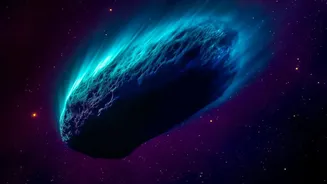
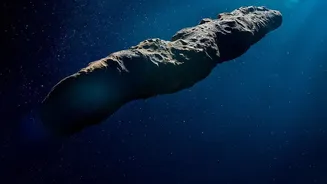
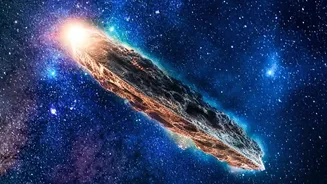
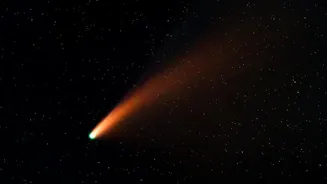
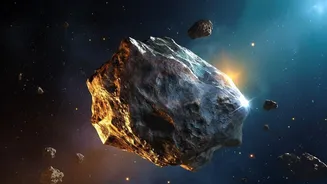
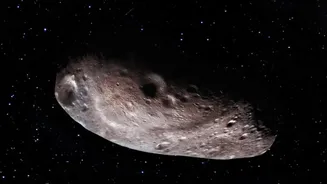
To date, scientists have confirmed a few key interstellar visitors. The first, 1I/ʻOumuamua, discovered in 2017, was a puzzle. It was oddly shaped, like a cigar or a flat pancake, and didn't have a visible tail like a typical comet, leading to much speculation. Then came 2I/Borisov in 2019, which looked and behaved much more like a conventional comet, complete with a fuzzy coma and tail. This suggested that our first visitor might have been the exception, not the rule. The discovery of 3I/ATLAS in 2025 further expanded our understanding, showing characteristics that suggest it could be an ancient relic, potentially over 11 billion years old.
Why These Visitors Matter
Studying these interstellar messengers is a revolutionary opportunity for science and technology. For most of history, everything we knew about the universe came from observing light. These objects are physical samples from other star systems, delivered right to our doorstep. By analyzing their composition and trajectories, astronomers can gain unprecedented insights into how planets and comets form around other stars. Each visitor is a time capsule from a distant, unknown corner of the galaxy, helping us understand how common or unique our own solar system is in the grand cosmic scheme. With new observatories like the Vera C. Rubin Observatory coming online, we expect to find many more of these interlopers in the coming years.