

In a remarkable display of international collaboration in space, India's Aditya-L1 solar observatory and the European Space Agency's Proba-3 mission have joined forces to study the Sun’s violent eruptions in unprecedented detail.
Two Missions, A Single Vision
At the heart of this collaborative
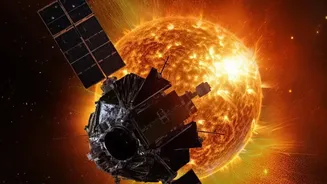
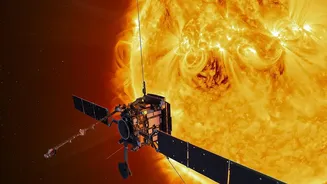
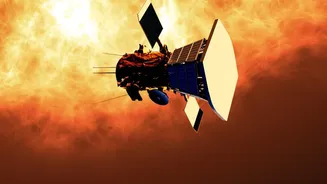
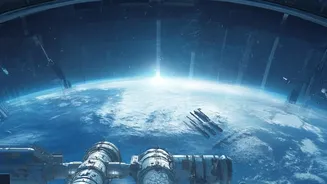
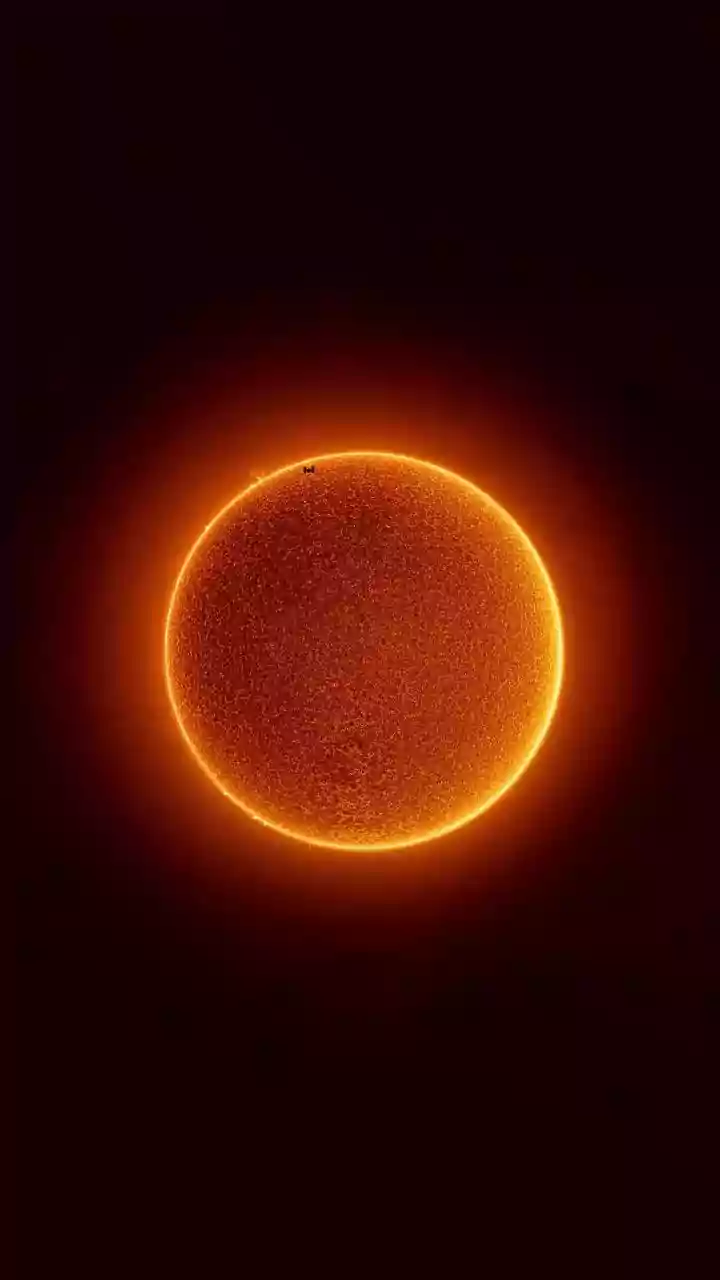
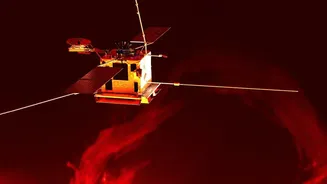
effort are two distinct but complementary space missions. Aditya-L1, India's first dedicated solar mission, was successfully placed into a halo orbit around the Sun-Earth Lagrange point 1 (L1) in January 2024. This strategic position allows it an uninterrupted view of the Sun. Its key instrument for this research is the Visible Emission Line Coronagraph (VELC), developed by the Indian Institute of Astrophysics (IIA) in collaboration with ISRO. VELC uses spectroscopy to analyse light from the Sun's corona, which helps scientists determine properties like the temperature and density of solar plasma. Partnering with Aditya-L1 is the ESA's Proba-3, a groundbreaking mission launched in December 2024 aboard an Indian PSLV rocket. Proba-3 consists of two satellites flying in precise formation, about 150 meters apart, to create an artificial solar eclipse. This allows its coronagraph, ASPIICS, to capture incredibly clear images of the Sun's faint outer atmosphere, or corona, revealing the shape, movement, and mass of solar eruptions.
Decoding Solar Fury
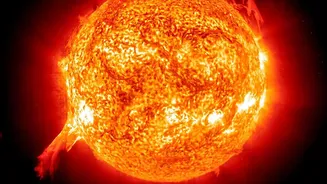
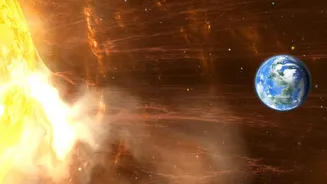
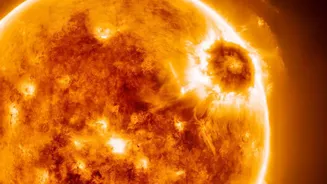
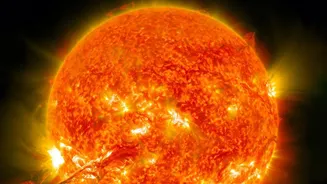
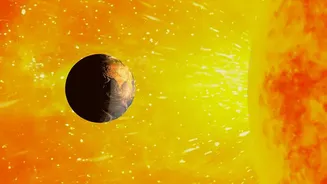
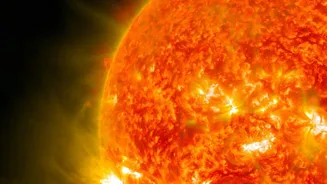
The focus of this joint study is a phenomenon known as a Coronal Mass Ejection (CME). CMEs are colossal explosions on the Sun that hurl billions of tonnes of magnetised plasma into space at immense speeds, ranging from under 250 km/s to nearly 3,000 km/s. These are not just distant cosmic events; when a CME is aimed at Earth, it can have significant consequences. These solar storms can disrupt our planet's magnetic field, threatening satellites, power grids, GPS services, and telecommunication networks. Understanding their properties right after they leave the Sun is therefore crucial for improving space weather forecasts.
A Partnership Delivers New Insights
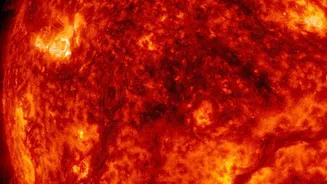
Observing the birth of a CME close to the Sun's blindingly bright surface has always been a major challenge for scientists. This is where the synergy between Aditya-L1 and Proba-3 becomes so powerful. While Proba-3's ASPIICS captures sharp images of the CME's structure and total mass, Aditya-L1's VELC provides spectroscopic data on the density and temperature of the erupting gas. By combining these two different types of observations, scientists can create a much more complete, three-dimensional picture of the eruption's initial moments. In a study published in the journal 'Astronomy & Astrophysics', researchers from the IIA and international partners analysed two CMEs that occurred on September 14 and 16, 2025, which were simultaneously observed by both missions. This provided the first opportunity to crosscheck measurements of a CME's mass, density, and energy using two independent, powerful instruments. The results showed excellent agreement, boosting confidence in the methods used.
Why Mass and Density Are Key
Measuring the mass and density of a CME is not just an academic exercise. These properties are fundamental to predicting its potential impact. A more massive and denser CME carries more energy and momentum, making it more likely to cause a significant geomagnetic storm upon arrival at Earth. The joint study revealed fascinating differences between the two observed eruptions. The CME on September 14 was fast, travelling at about 645 km/s, while the one on September 16 was much slower at 145 km/s. The slower CME's density was found to decrease more sharply with height, suggesting it expanded more rapidly in its early stages. Such details provide vital new constraints for the physical models that forecast how CMEs travel through space.
Protecting a Technology-Dependent World
This collaboration marks a significant step forward in our ability to monitor and understand the Sun's behaviour. The insights gained from joint Aditya L1 and Proba L3 observations will directly feed into improving space weather models. Better forecasting gives satellite operators, airline companies, and power grid managers more time to take protective measures, mitigating the potentially damaging effects of a solar storm. As our world becomes ever more reliant on spacebased technology, the ability to predict the journey and intensity of a CME is more critical than ever. This partnership between ISRO and ESA not only showcases the cuttingedge capabilities of both missions but also underscores the importance of international cooperation in tackling global scientific challenges.