





The Challenge of Finding Cosmic Pebbles
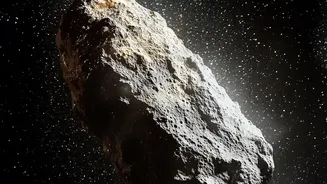
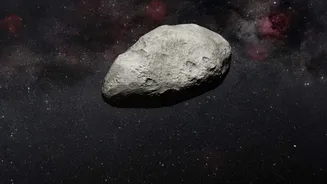
Spotting a city-killer asteroid years in advance is one thing; finding one the size of a car just hours before it arrives is another challenge entirely. Small asteroids, those just a few metres across, are incredibly faint. They don't produce their own
light, so telescopes can only see them by the faint sunlight they reflect. Until they get very close to Earth, they are virtually invisible against the vast, dark backdrop of space. This means that by the time they are bright enough for our telescopes to see, they are often only days or even hours away from entering our atmosphere. This short timeframe requires a very specific kind of detection strategy: one built for speed.
The Eyes on the Sky
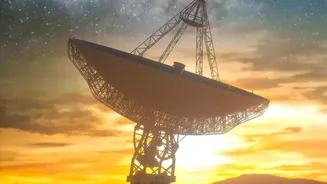
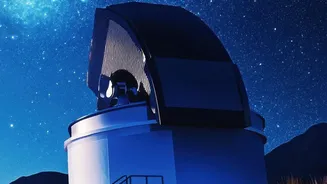
The front line of our planetary defence is a network of robotic survey telescopes. Projects like the Catalina Sky Survey (CSS) in Arizona and the Asteroid Terrestrial-impact Last Alert System (ATLAS), with telescopes in Hawaii, Chile, and South Africa, are designed for this exact purpose. Funded by NASA, these aren't necessarily the largest telescopes, but they are fast and have a wide field of view. Their mission is to scan huge sections of the night sky over and over again. For instance, the ATLAS system can scan the entire visible night sky every 24 hours. This rapid, repetitive scanning is the key to catching objects that suddenly appear on our cosmic doorstep.
Playing Spot the Difference
The detection method is conceptually simple but technologically complex. A survey telescope takes a picture of a patch of sky, and then a few minutes later, it takes another picture of the same spot. Powerful computer software then digitally subtracts one image from the other. Stars and galaxies, being fixed in their positions, vanish. But an asteroid, moving on its own orbital path, will have shifted its position between the two images. Instead of disappearing, it shows up as a point of light that has moved. This moving dot is the first clue that a potential near-Earth object has been found. The system automatically flags these moving candidates for further review.
From Detection to Confirmation
Finding a single moving dot isn't enough. The discovery needs to be confirmed. The initial data is sent to the Minor Planet Center (MPC), the global clearinghouse for all asteroid and comet observations. The MPC posts the potential object on a public page, calling on other astronomers—both professional and amateur—around the world to make follow-up observations. As more telescopes lock onto the object, they provide additional data points. Each new observation helps scientists refine the asteroid's orbit and predict its future path with greater accuracy. For an object on a collision course, this collaborative effort allows scientists to determine where and when it will enter the atmosphere.
A Race Against the Clock
This process can happen astonishingly quickly. On September 6, 2026, astronomers at the Mount Lemmon Observatory, part of the Catalina Sky Survey, discovered a small asteroid named 2026 RW1. It was just a metre across, and its trajectory showed it would hit Earth. The alert went out, and just seven hours after it was first spotted, the asteroid harmlessly disintegrated as a fireball over the Indian Ocean. This was only the 13th time in history that an asteroid had been detected before it impacted. These events, while not dangerous, serve as crucial real-world tests of our planetary defence systems, proving that our methods for finding even the smallest impactors are working and constantly improving.