



A Landmark Discovery
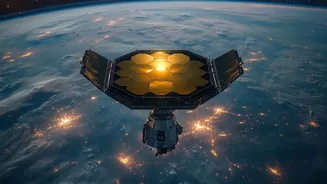
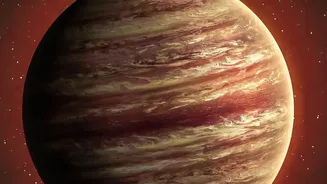
Astronomers have announced a groundbreaking finding from the powerful James Webb Space Telescope: the detection of water vapour on a super-Earth known as GJ 9827 d. This planet, located approximately 100 light-years away, is about twice the size of Earth.
While previous observations, including those from the Hubble Space Telescope, had hinted at the presence of water, JWST’s advanced instruments have provided the most substantial evidence to date, suggesting an atmosphere rich in water. This marks a pivotal moment, as it is one of the first times such a significant atmospheric component has been identified on a planet this small and rocky, moving beyond the gas giants where such discoveries are more common.
What is a Super-Earth?
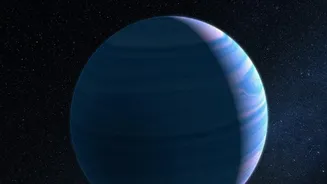
The term 'super-Earth' might sound like a planet perfectly suited for us, but it simply refers to a class of exoplanets with a mass higher than Earth's but substantially less than that of our solar system's ice giants, Neptune and Uranus. These planets are one of the most common types found in our galaxy, yet strangely, our own solar system doesn't have one. Super-Earths can be rocky, gaseous, or a combination of both. Their size and potential for retaining an atmosphere make them prime targets in the search for habitable worlds, as they are theoretically large enough to maintain geological activity and atmospheres, which are considered key ingredients for life.
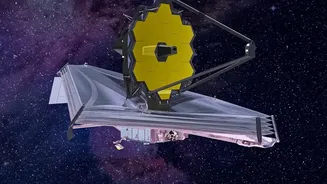
The Power of the Webb Telescope
So how did JWST make this incredible detection from 100 light-years away? It used a technique called transmission spectroscopy. As the exoplanet GJ 9827 d passed in front of its host star, the telescope carefully analyzed the starlight filtering through the planet's atmosphere. Different molecules in an atmosphere absorb specific wavelengths, or colours, of light. Water vapour leaves a very distinct chemical fingerprint in the light's spectrum. By measuring the starlight that was blocked, astronomers could identify the molecular signature of H2O. This method is so sensitive it can discern the atmospheric composition of planets that are otherwise just faint points of light, showcasing the revolutionary capability of the JWST.
A 'Steam World,' Not an Oasis
It is crucial to manage expectations. Finding water vapour does not mean we have found an ocean-covered paradise. In fact, GJ 9827 d orbits very close to its star, completing a full orbit in just over six Earth days. This proximity results in scorching surface temperatures, likely making it what some scientists are calling a 'steam world.' Rather than a temperate world with liquid water, the planet is likely shrouded in a thick, hot envelope of steam, making it inhospitable to life as we know it. The discovery is less about the habitability of this specific planet and more about proving that water-rich atmospheres can form and persist on smaller, rocky worlds.
The Search for Another Earth
This finding is a monumental proof of concept. For years, scientists have theorized about the existence of water worlds and steam worlds. The confirmation of one such planet with a water-rich atmosphere is a huge step toward understanding planet formation and diversity. It demonstrates that the tools are now in place to detect the building blocks of habitability on planets outside our solar system. The next step for astronomers is to use JWST to study other, more promising super-Earths—those orbiting within their star's 'habitable zone,' where temperatures could allow for liquid water. While GJ 9827 d is not Earth 2.0, its steamy atmosphere illuminates the path toward one day finding a world that is.