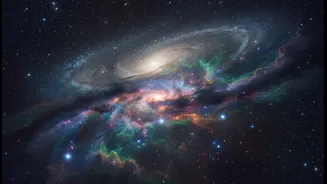





The Old, Cluttered Explanation
At the center of most large galaxies, including our own Milky Way, lurks a supermassive black hole. When these cosmic giants are actively feeding on surrounding gas and dust, the galaxy’s core lights up, becoming what astronomers call an Active Galactic
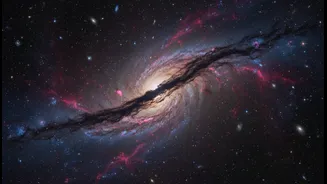
Nucleus, or AGN. For years, the standard explanation for the different appearances of these AGNs was the “unified model.” It proposed that every AGN was fundamentally the same: a black hole surrounded by a thick, doughnut-shaped ring of dust called a torus. According to this model, if we view the galaxy face-on, we can see directly into the bright center (a Type 1 AGN). If we view it from the side, the dusty doughnut blocks our view, and we see a different set of characteristics (a Type 2 AGN). It was an elegant idea, but as observations improved, the model started to fray. Astronomers kept finding AGNs that didn’t quite fit, forcing them to add more and more complexities and exceptions. The simple doughnut was becoming a very complicated piece of cosmic machinery.
A New, Unprecedented View
The problem was that no one could get a clear look. This central dust torus is incredibly dense, and telescopes that see in visible light, like the Hubble Space Telescope, couldn't penetrate the thick curtain of cosmic dust. Enter the James Webb Space Telescope. Webb is designed to see the universe in infrared light, which can pass through dense dust clouds that block other wavelengths. With its powerful and sensitive instruments, Webb can finally peer into the chaotic hearts of galaxies and see what is actually there. Recent observations of nearby active galaxies, such as the spectacular Centaurus A, have provided a revolutionary new perspective. What Webb is showing astronomers is not the neat, uniform doughnut they had long theorized about, but something far more dynamic and complex.
It’s Not a Doughnut, It’s a Fountain
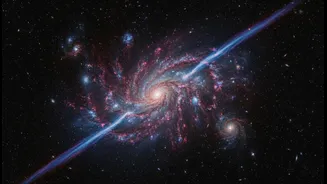
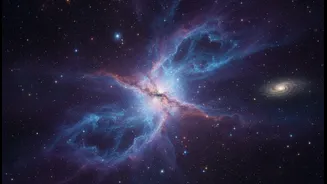
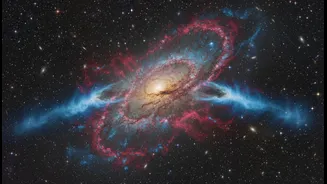
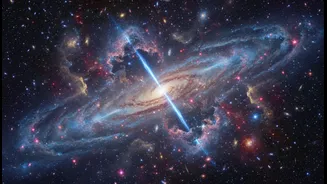
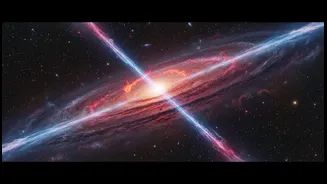
The latest findings, presented by international teams of scientists, suggest the “torus” is much less a solid ring and more a clumpy, dynamic collection of gas and dust. Rather than a single, stable structure, it appears to be a multi-phase system. Webb’s data reveals that in many cases, what was thought to be a simple torus is actually composed of several parts: a thinner, equatorial disk feeding the black hole, and a significant amount of dust being driven away in a “polar wind” perpendicular to the disk. Imagine a fountain instead of a doughnut. Some material flows inward along the middle, while a portion is shot upward and outward. This polar dust, heated by energy from the AGN, helps explain many of the features that were previously shoehorned into the old model. For example, observations of the galaxy Circinus show that most of the dust is in a compact disk, with only a tiny fraction forming an outflowing arc. This more realistic physical picture provides a better framework for understanding the variety of AGNs we observe.
Why a New Model Is Better
While a dynamic fountain of gas and dust might sound more complex than a simple doughnut, it actually makes the overarching theory much simpler and more powerful. Instead of needing a zoo of different torus types and ad-hoc rules to explain why some AGNs look one way and others another, the new model based on Webb’s data can account for this diversity more naturally. The variations can be explained by viewing a single, dynamic system from different angles, or at different moments in its evolution. It unifies observations by providing a more accurate description of the underlying physics. This breakthrough is a perfect example of the scientific process. A simple model worked for a while, but as data got better, its weaknesses were exposed. Now, a more powerful instrument has provided the evidence needed for a new, more robust model that brings us closer to understanding how these powerful cosmic engines truly work and how they influence the galaxies they inhabit.