




The Challenge of Robotic Dexterity
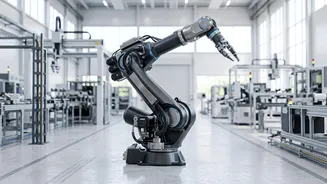
In the vast landscape of automation, one major frontier has remained stubbornly human: dexterous manipulation. While industrial robots have transformed structured environments like car manufacturing, a huge portion of the global economy—from e-commerce
logistics and food production to electronics assembly—still relies on the sensitivity and adaptability of human hands. The reason is simple: the real world is messy and unpredictable. Objects come in infinite shapes and sizes; some are fragile, others are slippery, and many are presented in cluttered, unplanned ways. Traditional robots, programmed for precise, repeatable motions in a fixed environment, falter when faced with such variability. This 'last millimeter' problem of grasping has been a significant barrier to the next wave of automation.
Enter Eka Robotics
A Cambridge, Massachusetts-based startup named Eka Robotics has emerged from stealth with a solution that has investors and roboticists taking notice. Founded by MIT professor Pulkit Agrawal and former Google DeepMind researcher Tuomas Haarnoja, the company recently secured a $150 million Series A funding round, achieving a remarkable valuation of $1.45 billion. Eka's mission is to build intelligence for the physical world, creating general-purpose robots that can perform work beyond human capabilities and operate safely alongside people. They are not just trying to make a better gripper; they are fundamentally rethinking how a robot understands and interacts with its environment.
The Secret Sauce: Vision, Force, and Action
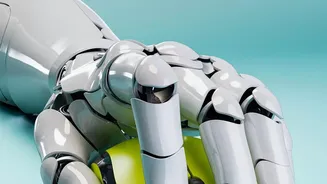
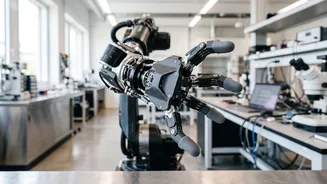
At the core of Eka's innovation is its proprietary 'Vision-Force-Action' (VFA) model. Unlike many AI systems that rely primarily on vision, Eka's technology integrates visual perception with rich data from force sensors embedded in its custom-designed robotic hand. This means the robot doesn't just see an object; it feels it. Co-founder Pulkit Agrawal explained that vision gets the robot close, but the final, delicate act of grasping is governed by force. If a robot feels a grip starting to slip or encounters unexpected resistance, it can correct its motion in real-time, much like a person would. This ability to use physical contact as a source of information is a paradigm shift from models that simply try to mimic pre-recorded human actions.
Training for Superhuman Performance
The results of this approach are staggering. Eka's robots can reportedly pick and place a wide variety of objects—many of which it has never encountered before—at a rate of 1,500 items per hour. This is roughly two and a half times faster than the human baseline of about 600 items per hour, all with a success rate exceeding 95 percent. The key to achieving this is how the robots learn. Instead of relying on time-consuming human demonstrations, Eka trains its AI models through reinforcement learning in a hyper-realistic physics simulator. In this virtual world, the robot can practice for millions of hours, experiencing countless variations of objects, physics, and potential failures. This allows the system to build a deep, intuitive understanding of physical interaction that translates directly to the real world.
A New Era for Automation
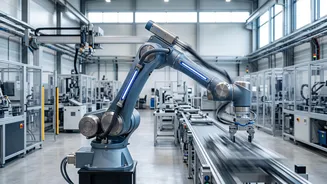
The ability to reliably handle a diverse range of items opens up automation to industries that were previously out of reach. In e-commerce warehouses, these robots could handle the endless variety of products customers order and return. In agriculture, they could delicately harvest fresh produce without bruising it. In manufacturing, they can perform complex, contact-rich tasks like inserting wires or assembling delicate components. Eka's breakthrough represents a significant step toward 'physical AI'—intelligent systems that can navigate and manipulate the unstructured physical world as easily as software navigates the digital one. While the company still needs to prove its technology can withstand the rigors of real-world industrial deployments, its approach has experts heralding a new chapter in robotics.