





The Tyranny of a Three-Second Delay
Controlling a robot on the Moon from Earth isn't like playing a video game. Due to the vast distance, there's a communication lag of about 2.5 to 3 seconds for a round trip. Send a command, and you won't see the result for nearly three seconds. This delay
makes real-time control, or teleoperation, of complex machinery incredibly difficult and dangerous. A simple error in maneuvering a crane or excavator could lead to mission-critical damage that can't be easily fixed 384,000 kilometres away. For tasks that require precision, like assembling structures or connecting power cables, this latency turns a simple job into a nearly impossible one. As a result, space agencies and commercial partners have concluded that for construction to be feasible, the machines must think for themselves.
What 'Autonomous' Really Means
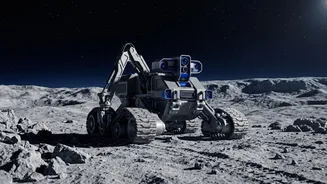
Autonomy in this context is far more than just running a pre-written program. Future lunar construction robots will be equipped with sophisticated artificial intelligence and a suite of sensors, like advanced cameras and LiDAR, to perceive and map their surroundings in 3D. Instead of receiving step-by-step instructions, a robot might be given a high-level goal, such as 'clear and level this 50-square-metre area for a landing pad'. The robot would then be responsible for scanning the terrain, identifying obstacles, planning the most efficient path, and executing the job without human intervention. Companies like GITAI are developing robotic arms and rovers with onboard AI decision-making layers, allowing them to perform complex tasks with minimal oversight. This move from programmed machines to intelligent partners is seen as a critical leap for long-term space exploration.
The To-Do List for a Lunar Robot
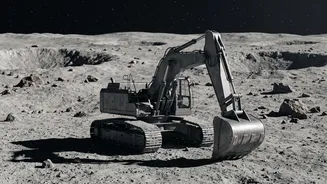
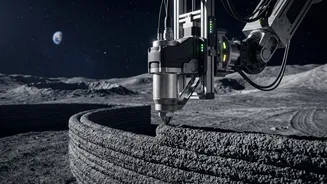
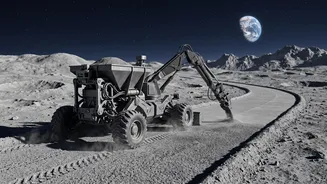
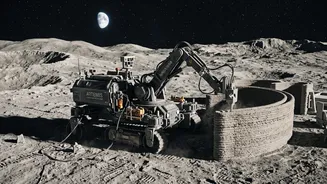
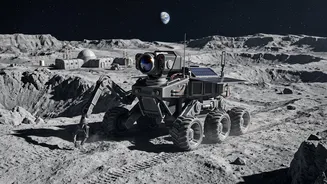
The first robotic inhabitants of the Moon will be blue-collar workers. Their primary job will be to prepare a safe and functional environment for human astronauts. This includes crucial tasks like building landing pads to prevent rocket exhaust from kicking up abrasive lunar dust at high velocity. They will be tasked with constructing berms and other simple structures from local lunar soil, known as regolith, to provide radiation shielding for habitats. Other jobs on the list include digging trenches for power cables, deploying solar panels and communication antennas, and even 3D-printing building components using melted regolith. Projects like NASA's Project Olympus are specifically focused on developing these 'off-world construction' technologies, partnering with companies that have pioneered 3D-printing and robotics on Earth.
Swarms, Not Lone Wolves
Building a lunar base is too big a job for one robot. The emerging model is one of robotic 'swarms' that can collaborate on a single objective. Using decentralized software, a team of rovers can divide tasks dynamically. For instance, if one robot's job is to excavate a foundation and it encounters an unexpectedly hard rock, it could signal for another robot with a drilling tool to come and assist. This swarm intelligence makes the entire system more resilient; if one robot breaks down, the others can adapt and continue the mission without waiting for commands from Earth. This approach mirrors advancements in terrestrial logistics and automation but is adapted for the unique and unforgiving lunar environment, where hardware failure is a constant risk.
Paving the Way for Human Return
Ultimately, these autonomous construction systems are enablers for human exploration. Space agencies like NASA and the European Space Agency (ESA) envision a future where robotic teams are sent ahead to a landing site to build essential infrastructure before the first astronauts even lift off. This means that when the crew arrives, they will find landing zones, habitats, and power systems already in place. This strategy not only increases safety but also allows astronauts to focus on higher-value scientific and exploration tasks rather than basic construction. The development of these robots is a global effort, with commercial companies and space agencies from the US, Europe, and China all developing roadmaps for intelligent robotics on the Moon. These efforts are turning the science-fiction vision of a lunar base into a concrete engineering plan, with the first robotic builders leading the way.