






A 'Steam World' Comes into Focus
Astronomers have confirmed that the exoplanet GJ 9827 d, located nearly 100 light-years away, is a first-of-its-kind 'steam world'. Roughly twice the size of Earth, this planet is not just a world with a bit of water; its atmosphere appears to be composed
almost entirely of water vapour. This groundbreaking discovery confirms a new type of planet in our galactic neighbourhood and provides a real-world laboratory for studying water-rich environments, a crucial step in understanding planetary formation across the cosmos.
More Than Just a Hint of Water
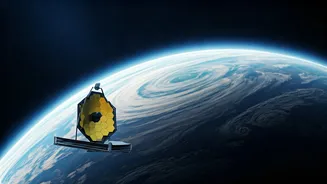
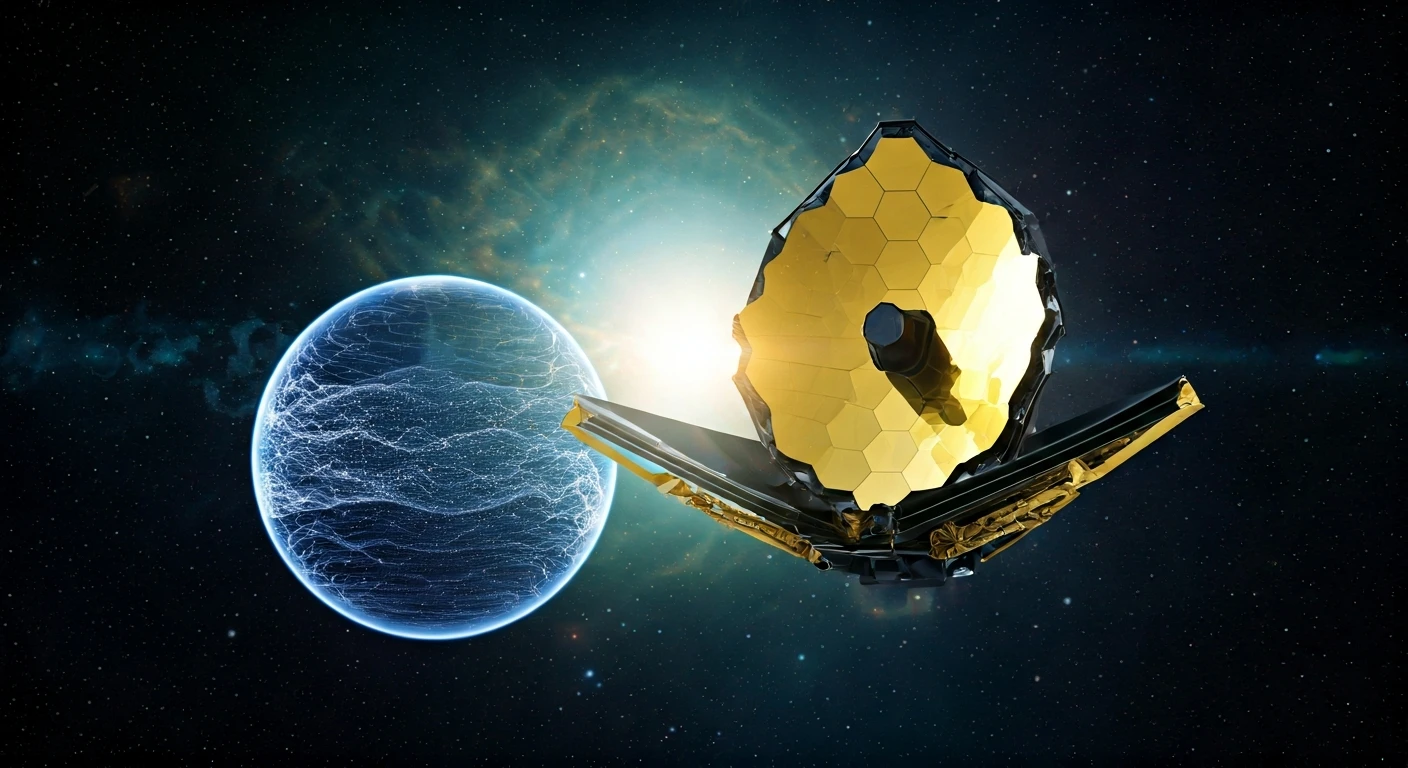
The journey to this discovery began with earlier observations. NASA's Hubble Space Telescope had previously detected tantalizing hints of water in GJ 9827 d's atmosphere. However, the data was not detailed enough to determine if it was a trace amount in a hydrogen-rich atmosphere or something more substantial. It took the unparalleled power and precision of the James Webb Space Telescope to make the definitive call. Using its advanced infrared instruments, Webb captured a clear and unambiguous signal, revealing that the planet is metaphorically drowning in hot steam.
How Webb Reads an Alien Sky
To achieve this, scientists used a technique called transmission spectroscopy. As GJ 9827 d passed in front of its host star, the JWST carefully measured the starlight that filtered through the planet's atmosphere. Different molecules absorb light at specific wavelengths, leaving a unique chemical fingerprint in the spectrum of light that reaches the telescope. For GJ 9827 d, the signature of water was overwhelmingly strong, detected by Webb's Near-Infrared Imager and Slitless Spectrograph (NIRISS) instrument during two separate transits. This powerful technique allows astronomers to deconstruct the chemistry of worlds light-years away.
Not a Habitable Oasis
While the idea of a water world sounds tantalizingly close to a habitable planet, GJ 9827 d is no paradise. Orbiting very close to its star, the planet is incredibly hot, preventing the existence of liquid water oceans. Scientists theorize that deep within its atmosphere, the immense pressure could force water molecules into exotic states of matter, like supercritical fluids or strange forms of hot ice, meaning there may not even be a solid, rocky surface beneath the steamy skies. Life as we know it would not stand a chance in such an extreme environment.
A Key Clue in the Search for Life
So why is this discovery so important? Because GJ 9827 d is a sub-Neptune, a class of planet that is the most common in our galaxy, yet completely absent from our own solar system. Understanding how these planets form and retain their atmospheres, especially one so rich in a heavy molecule like water, is a fundamental piece of the planetary science puzzle. By studying this extreme 'steam world' in detail, astronomers can refine their models and techniques, preparing them for the ultimate prize: analyzing the atmospheres of smaller, cooler, rocky planets that lie in the habitable zone of their stars.