



The First Clue: Following the Path
The very first piece of evidence is the object's movement. By taking multiple images over hours or days, astronomers can track its path across the sky. This allows them to calculate an orbit. Objects within our solar system, like asteroids and comets,
follow elliptical orbits around the Sun. The shape of this orbit provides vital clues. A relatively circular orbit often suggests an asteroid from the main belt between Mars and Jupiter. A highly elongated orbit points towards a comet, which travels from the frigid outer reaches of the solar system. If an object's trajectory is an open-ended hyperbola, it means it's moving too fast to be captured by the Sun's gravity, indicating it's an interstellar visitor from another star system. This orbital data is the foundation upon which all other analysis is built and is crucial for determining if a near-Earth object could pose a future threat.
Reading the Rainbow: A Chemical Fingerprint
One of the most powerful techniques for identifying a space rock is spectroscopy. This method involves analyzing the light that reflects off the asteroid's surface. Just as a prism splits white light into a rainbow, a spectrometer breaks down the faint light from an asteroid into its component wavelengths. Different minerals and elements absorb and reflect specific colours of light in a unique way. This creates a 'chemical fingerprint' in the light's spectrum. By comparing this signature to the known spectra of minerals and materials found in meteorites on Earth, scientists can infer the asteroid's composition without ever leaving the ground. This helps them classify the object into broad families, such as carbonaceous (C-type), stony or siliceous (S-type), and metallic (M-type) asteroids.
Shine and Spin: Brightness and Rotation
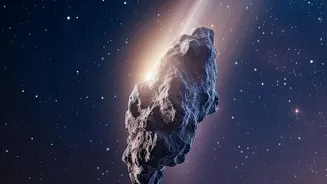
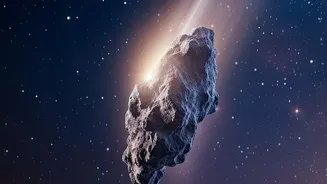
How an asteroid's brightness changes over time provides clues about its physical nature. As an irregularly shaped object tumbles through space, the amount of surface area reflecting sunlight toward Earth changes, causing its brightness to fluctuate. By monitoring these regular variations, called a light curve, astronomers can determine the asteroid's rotation period—how fast it's spinning. The amount of fluctuation can also hint at whether the object is elongated like a potato or more spherical. Furthermore, by measuring an object's albedo, or its overall reflectivity, scientists can make estimates about its composition and size. Dark, carbon-rich asteroids (C-type) reflect very little light, while stony (S-type) asteroids are moderately reflective. This data, combined with other observations, helps build a more complete picture of the object.
An Active Approach: Radar Imaging
For near-Earth objects that pass relatively close, scientists can go from passive observation to active investigation using planetary radar. Powerful ground-based antennas, like those at the Goldstone Solar System Radar, send a radio signal toward the asteroid and analyze the echo that bounces back. This technique offers remarkably detailed information. By measuring the timing of the returning signals, scientists can create detailed 3D models of the asteroid's size and shape, sometimes with a resolution of just a few metres. Radar can also reveal surface properties, like whether it's a solid body or a loose collection of rubble, and even discover if the asteroid has its own tiny moon. This information is invaluable for planetary defense, as it helps us understand the structure of potentially hazardous asteroids.
Ground Truth: Analyzing Fallen Visitors
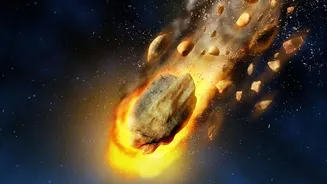
The most direct evidence comes from meteorites—pieces of asteroids that survive the fiery journey through our atmosphere and land on Earth. Scientists can analyze these rocks in a laboratory using a variety of methods. Techniques like mass spectrometry and electron microscopy reveal the precise mineral and chemical composition, including the presence of metals like iron and nickel. This 'ground truth' is essential for calibrating the interpretations of data gathered from telescopes. By matching the spectroscopic signature of an asteroid in space to the detailed analysis of a meteorite in the lab, scientists can confirm the composition of entire asteroid families that are millions of kilometres away.