





More Than Just Footprints
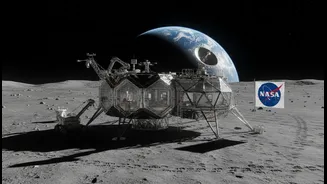
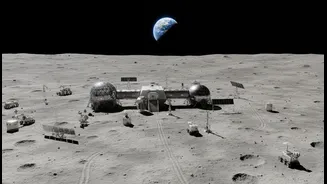
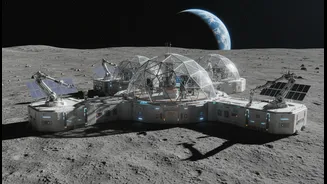
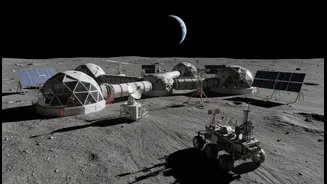
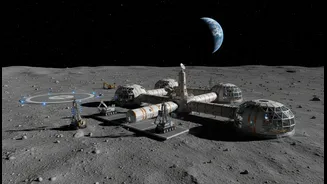
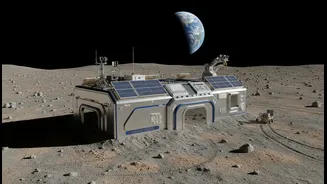
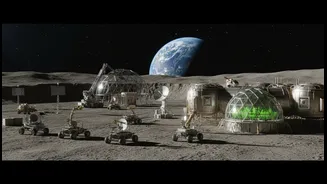
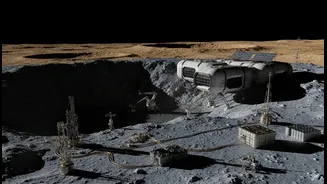
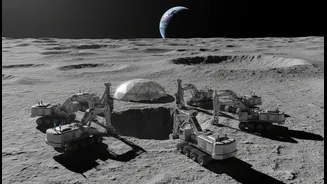
The guiding philosophy of the Artemis program marks a fundamental shift from the Apollo era. The goal is no longer a temporary visit but establishing a “sustained presence” on the Moon. This vision is embodied in the Artemis Base Camp, a planned outpost
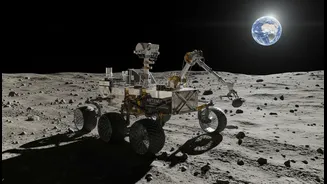
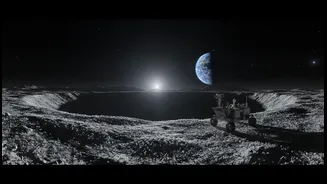
near the lunar South Pole. This location is strategically chosen for its potential access to water ice hidden in permanently shadowed craters. The base camp is envisioned to include a surface habitat, a lunar terrain vehicle (LTV) for short trips, and a pressurized rover for longer expeditions, allowing astronauts to live and work on the Moon for weeks or even months at a time. This long-term approach is designed not only for lunar discovery but also as a crucial proving ground for the technologies needed for the even greater leap to Mars.
The Scientific To-Do List
A permanent base unlocks a new era of lunar science, far beyond what the brief Apollo missions could achieve. Key objectives include understanding planetary processes, interpreting the impact history of the Earth-Moon system, and studying lunar polar volatiles like water ice. Geologists are eager to analyze lunar rocks and soil to piece together the 4.5-billion-year history of the Moon, which holds clues to the evolution of our own planet. Furthermore, the Moon offers a unique, stable platform for observing the universe and Earth without the interference of a thick atmosphere. Scientists hope to deploy geophysical monitoring stations and telescopes, turning our celestial neighbour into a premier astronomical observatory.
Living Off the Lunar Land
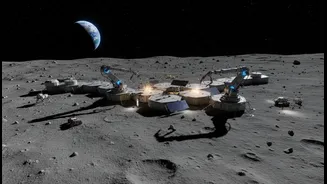
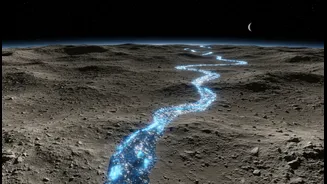
The single biggest key to a sustainable lunar presence is mastering In-Situ Resource Utilization (ISRU), or the ability to use local materials. Shipping every necessity from Earth is prohibitively expensive; the rocket equation makes every kilogram of cargo a costly burden. Water ice is the most critical resource. If it can be successfully mined from the lunar soil, it can be split into hydrogen and oxygen. This provides breathable air for astronauts and, crucially, the two primary components of rocket propellant. This would effectively turn the Moon into a refueling station for missions deeper into the solar system. Scientists are also developing methods to use lunar regolith—the loose dust and rock on the surface—as a building material, potentially 3D printing structures and radiation shielding, further reducing dependency on Earth.
A Step-by-Step Approach
Establishing the base camp is not a single event but a carefully choreographed sequence of missions. Artemis I, an uncrewed test flight, successfully flew in 2022. Artemis II, which completed a crewed lunar flyby in April 2026, took humans farther from Earth than ever before and tested the Orion spacecraft's life-support systems with astronauts aboard. Future missions are slated to build on this progress. Artemis III, scheduled for 2027, will test commercial landing systems in Earth orbit. Artemis IV, targeting early 2028, is planned to be the first crewed landing of the program. Subsequent missions aim to launch roughly once per year, delivering the habitat, rovers, and power systems needed to bring the base camp to life.
A Global, Collaborative Effort
Unlike the Cold War space race, the modern lunar push is defined by international and commercial partnerships. The Artemis Accords, a set of principles for cooperation in space, have been signed by dozens of nations. The European Space Agency (ESA) provides the critical service module for the Orion spacecraft, which supplies power and life support. Japan is developing a pressurized rover for long-duration surface missions, and Canada is contributing advanced robotics with the Canadarm3. Commercial companies like SpaceX and Blue Origin are developing the human landing systems that will ferry astronauts to the surface, bringing private sector innovation and competition into the fold.