





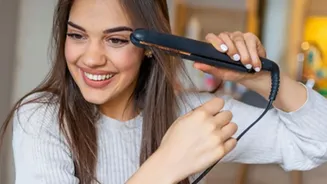
Coloring your hair is an investment of time and money. So why let that vibrant new shade fade away? High-heat styling is a top cause of color loss, but a simple step can make all the difference in protecting your hair's health and hue.
How Heat Fades Your Color
To understand the
solution, you first need to understand the problem. High temperatures from a blow-dryer do more than just dry your hair; they can weaken its core structure. Each hair strand has a protective outer layer called the cuticle. Heat causes this layer to lift, creating an escape route for the color molecules that are meant to be sealed inside. This process not only dulls your color but also strips the hair of its natural moisture, leading to that dry, brittle feeling and an increase in frizz. Color-treated hair is especially vulnerable because the coloring process itself makes the hair more porous and susceptible to this type of damage.
The Science of a Heat Shield
A heat protectant acts as a defensive barrier between your hair and the hot air. These products work in a few clever ways. First, they form a thin film on the surface of the hair shaft. This film slows down how quickly your hair heats up and helps distribute the heat more evenly, preventing 'hot spots' that can scorch individual strands. Second, this barrier seals in moisture, which is crucial for maintaining your hair's elasticity and strength. By smoothing and sealing the cuticle, a good protectant also reduces friction, making the hair feel smoother and appear shinier.
Decoding the Ingredient List
Not all protectants are created equal, and the ingredients tell the real story. Look for film-forming polymers and silicones, like dimethicone and cyclomethicone. These are the workhorses that create the protective shield and give hair that smooth, easy-to-comb feel. Many formulas also include humectants like glycerin and panthenol, which attract and retain moisture. For an extra boost, some products contain nourishing components like hydrolyzed proteins (such as keratin) and natural oils, which help strengthen the hair fiber. Some even include antioxidants to help counteract damage from free radicals generated by heat tools.
Application: Your Technique Matters
Simply misting the top layer of your hair won't cut it. For a heat protectant to be effective, it needs to be applied correctly. Start with clean, towel-dried hair that is damp but not soaking wet. Excess water will dilute the product. Divide your hair into manageable sections. Hold the bottle about 15-20 cm away and spray each section lightly and evenly from the mid-lengths to the ends, as these areas are the most fragile. Don't forget the under-layers and the hair around your face. Once applied, use a wide-tooth comb to gently distribute the product through your hair, ensuring every strand is coated before you pick up the blow-dryer.
Common Mistakes to Avoid
Even with the best product, a few common errors can sabotage your efforts. The biggest mistake is not using enough product, leaving sections of your hair vulnerable. Another is applying it only to the top layer while ignoring the hair underneath. Layering too many heavy silicone or oil-based products before your heat protectant can also be counterproductive, potentially 'frying' the hair instead of protecting it. Finally, remember that a protectant reduces damage—it doesn't make your hair invincible. Always use the lowest effective heat setting on your dryer and avoid going over the same section repeatedly. Your color (and your hair) will thank you for it.