



For those with naturally curly hair, the quest for defined, frizz-free ringlets can feel like a constant battle. But what if the secret isn't just the products you use, but when you apply them? Enter damp styling, a game-changing technique.
The Science of a Single Strand
To understand
why damp styling works, we first need to look at the structure of a hair strand. Each strand is protected by an outer layer called the cuticle, which is made of overlapping scales. In curly hair, these 'shingles' are naturally more raised and open than in straight hair. This is why curly hair is more prone to dryness and frizz—moisture escapes easily through these gaps. When your hair is soaking wet, the cuticles are swollen and wide open. Applying products at this stage can be effective for hydration but also means you're using a lot of product that might just get diluted and drip away with the excess water. Your hair is also at its most fragile and easily stretched, which can disrupt your natural curl pattern.
Finding the Damp-Styling Sweet Spot
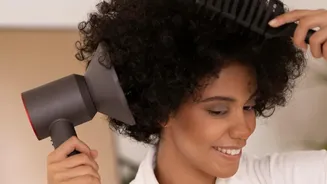
Damp styling targets the ideal moment when the hair cuticle has started to close but is still receptive enough to absorb products. Think of it as hair that is no longer dripping but is still evenly moist—around 60-80% wet. Styling at this stage offers several key benefits. First, it allows for better curl clumping and definition because the hair isn't weighed down by excess water. This often translates to more volume at the roots. Second, you get more control over your product application; you can feel where the product is going and use less of it more effectively. And finally, it significantly cuts down on drying time, whether you air-dry or use a diffuser.
How to Achieve Perfectly Damp Hair
Getting your hair to the right level of dampness is an art, but a simple one to master. The most popular method is 'plopping' or 'micro-plopping'. After washing and conditioning, instead of rubbing your hair with a rough terrycloth towel (a major cause of frizz), gently squeeze out excess water. Then, apply your leave-in conditioner or curl cream to your wet hair. Next, lay a microfiber towel or an old cotton t-shirt on a flat surface, flip your hair forward, and 'plop' it onto the fabric. You can either wrap it up for 10-20 minutes ('plopping') or use the fabric to gently scrunch sections of your hair upwards towards the scalp ('micro-plopping'). Both techniques absorb excess water without disrupting your curl pattern, leaving you with perfectly damp hair ready for styling.
Applying Products for Maximum Definition
Once your hair is damp, it’s time to apply your hold products, like a gel or mousse. Because there's less water, the product can form a more concentrated 'cast' around your curls, which is key for long-lasting definition and frizz control. Divide your hair into sections to ensure every strand is coated. You can use the 'praying hands' method (smoothing product down the hair shaft between your palms) or the 'raking' method (using your fingers like a rake to distribute product). For extra definition, you can finger-coil individual curls. The goal is to encourage your natural curl pattern without creating frizz, so handle your hair gently.
Common Mistakes to Avoid
While damp styling is transformative for many, a few common errors can trip you up. The biggest is letting your hair get too dry before applying stylers, which can lead to stringy, frizzy results. If you notice frizz forming as you style, don't be afraid to re-wet sections with a misting spray bottle. Another mistake is using the wrong towel; a standard bath towel will rough up the cuticle and undo all your hard work. Finally, avoid touching your hair while it dries. Once your products are in, let them set. Disturbing the curls before the cast has fully formed is a direct invitation for frizz and flyaways to appear.