

From Space Rock to Shooting Star
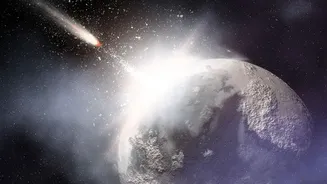
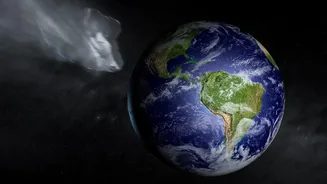
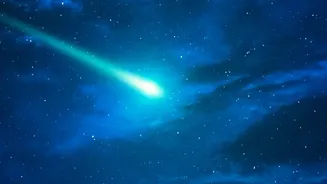
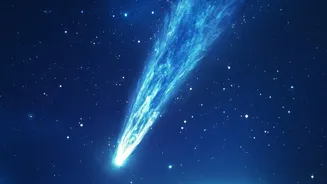
First, a quick vocabulary lesson that’s out of this world. While floating in space, a rock is called a meteoroid. It can be anything from a tiny dust grain to a small asteroid. When it hits Earth’s atmosphere at incredible speed and burns up, that fiery
trail we see is a meteor, or a “shooting star.” If any part of it survives the intense journey and lands on the ground, that surviving piece is called a meteorite. It’s this final stage—the meteorite—that holds the most precious clues. But to find it, scientists must first track its dramatic fall.
Eyes on the Sky: Tracking the Fall
Catching a meteor in the act requires a network of vigilant observers. Organizations like NASA's All-Sky Fireball Network use a system of cameras to constantly watch the sky for meteors brighter than Venus. When a fireball is spotted by multiple cameras, scientists can use triangulation to reconstruct its path through the atmosphere. This helps them calculate its trajectory, speed, and deceleration. Sometimes, even weather radar can be used to track the falling pieces after the visible fire has gone out, a phase known as “dark flight,” which helps narrow down the search area on the ground.
The Cosmic Treasure Hunt
Once a potential landing zone is identified, the hunt begins. Finding a meteorite is challenging; they can often look like ordinary Earth rocks. However, there are tell-tale signs. Most meteorites have a dark, glassy exterior called a fusion crust, which forms when the outer surface melts during atmospheric entry. Many are also denser than terrestrial rocks due to a higher concentration of iron and nickel, which often makes them magnetic. The shape can be another clue, with some showing shallow indentations resembling thumbprints, created by the turbulent flight.
Inside the Lab: Reading a Meteorite’s Story
Back in the laboratory, the real detective work starts. Scientists slice the rock open to study its internal structure and composition. One of the first things they look for are chondrules—tiny, round mineral grains that are among the oldest solid materials in our solar system. Their presence indicates a “primitive” meteorite that has remained largely unchanged for billions of years. By analysing the chemical makeup, scientists can determine if the rock came from an asteroid's crust or its dense, metallic core. For example, a Widmanstätten pattern, a unique interlocking crystal structure of iron-nickel alloys, proves the material came from the core of a large, shattered asteroid.
Unlocking Solar System Secrets
Perhaps the most powerful clues are hidden in the isotopes—different forms of the same element. The specific ratios of isotopes of elements like oxygen and potassium act like a cosmic fingerprint. These signatures can tell scientists where in the solar system the meteorite originated, whether from the inner regions near Earth or the colder outer reaches beyond Jupiter. By comparing a meteorite's composition to data from space missions, scientists can sometimes even trace it back to a specific parent body, like the asteroid Vesta, or even another planet like Mars or the Moon. These tiny rocks carry a direct record of the conditions and building blocks that formed our planets over 4.5 billion years ago.