


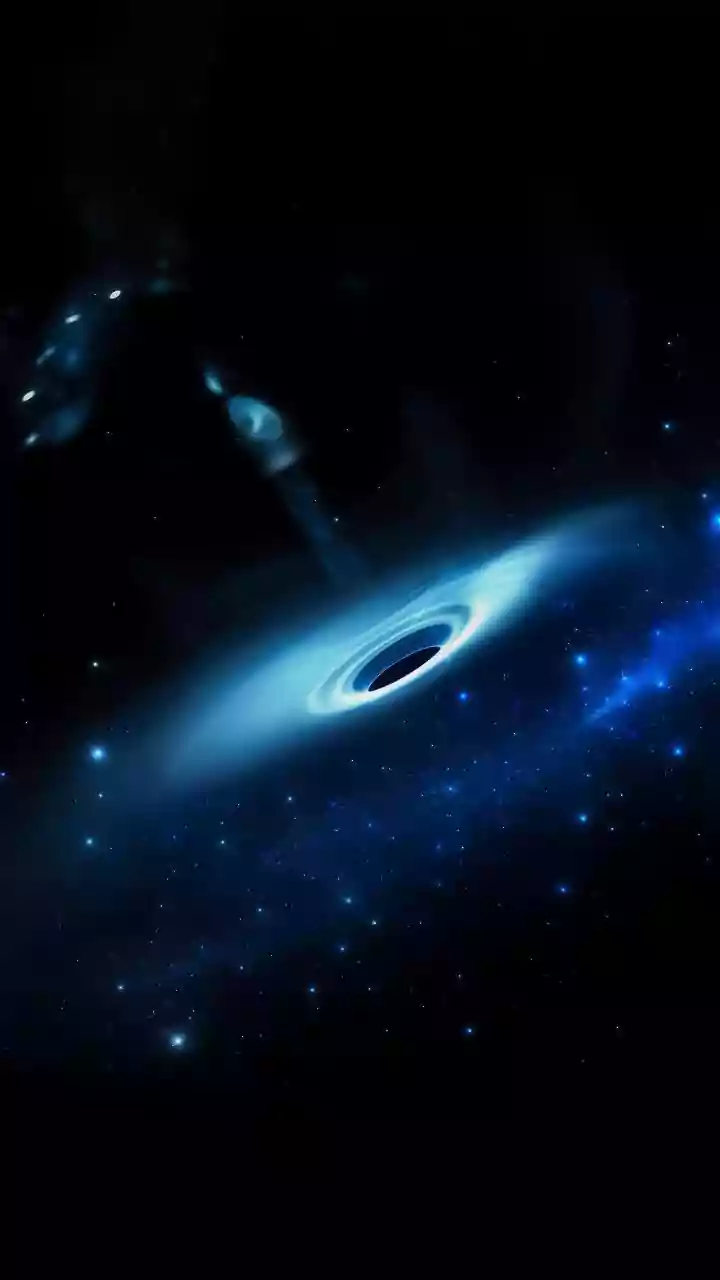



Seeing the Unseeable with X-rays
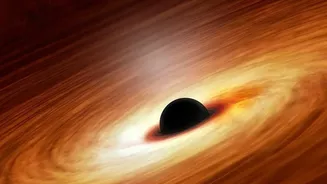
You can't take a picture of a black hole in visible light because its gravity is so strong that not even light can escape. So, how do we study them? Astronomers look for the chaos a black hole creates. As gas, dust, and stars are pulled towards a black hole,
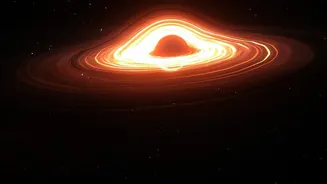
they form a swirling traffic jam of matter called an accretion disk. The immense gravitational forces and friction in this disk heat the material to millions of degrees, causing it to glow brightly not in visible light, but in high-energy X-rays. X-ray telescopes in space, which operate above Earth's obscuring atmosphere, are our primary eyes for watching this process. They can detect this X-ray light and tell us about the extreme physics happening at the very edge of the black hole's event horizon.
A Decade-Long Stare into the Abyss
A single snapshot in time can only tell you so much. To truly understand a complex, evolving system, you need to watch it over a long period. This is where more than a decade of data from missions like NASA's NuSTAR (Nuclear Spectroscopic Telescope Array) becomes invaluable. Launched in 2012, NuSTAR is uniquely sensitive to high-energy X-rays, allowing it to peer through clouds of gas and dust that hide many black holes from other telescopes. By compiling ten years of continuous observations, astronomers can move beyond static images. They can track changes, identify patterns, and build a cohesive story of a black hole's behaviour. Combining this long-term data with information from other observatories like Chandra and XMM-Newton gives scientists an even more complete picture.
Charting the Cosmic Weather
So, what are 'thermal dynamics'? In simple terms, it’s the 'weather' occurring in the superheated gas around the black hole. It involves tracking how matter heats up, cools down, and moves around in the accretion disk and the even hotter region above it, called the corona. This isn't a calm, smooth flow; it's a turbulent, chaotic environment with powerful magnetic fields, bright flares, and gusting winds of particles. Understanding these dynamics is key. For example, astronomers can use a technique called 'X-ray reverberation mapping', where they watch for flares of X-rays from the corona and then measure the time it takes for that light to 'echo' off the accretion disk. This delay helps them map the distance and geometry of the structures right next to the black hole.
From Data Points to a Dynamic Map
A decade's worth of X-ray data allows astronomers to build the first truly dynamic 'maps' of these extreme regions. This isn't a geographical map, but a physical one—a computer model that simulates the behaviour of the gas. By tracking how the temperature and brightness of the accretion disk change over time, scientists can test fundamental theories about gravity. For instance, NuSTAR's long-term observations have helped provide unambiguous measurements of black hole spin—the degree to which a black hole drags spacetime around with it. These maps also reveal how a black hole 'feeds'. Sometimes it snacks quietly, while other times it has large, dramatic feasts that can be seen across the universe.
Why This Cosmic Mapping Matters
Mapping the area around a black hole does more than satisfy our curiosity. These objects are fundamental engines of cosmic evolution. The energy and matter they eject in winds and jets can influence their entire host galaxy, regulating how many new stars are formed. By understanding the thermal dynamics of a single black hole, we learn about the forces that shape the large-scale structure of the universe. Furthermore, these environments are the ultimate laboratories for testing Albert Einstein's theory of general relativity under conditions that can never be recreated on Earth. Each X-ray photon collected over the last decade provides another piece of the puzzle, helping us understand these gravitational behemoths and their role in the cosmos.