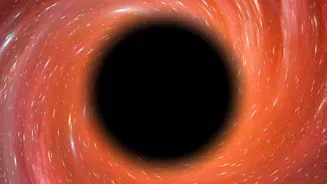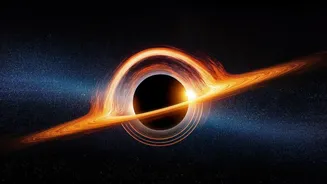







In the cosmic rulebook, black holes are famous for merging, not splitting. But what if that rule could be broken? New theoretical research explores this very question, suggesting a loophole that could, under extreme conditions, allow one black hole to
divide.
The Cosmic One-Way Street
For decades, our understanding of black holes has been governed by a seemingly unbreakable principle rooted in Einstein's theory of general relativity. Popularized by Stephen Hawking, the 'area theorem' states that the total surface area of a black hole's event horizon—the point of no return—can never decrease. This means when two black holes collide and merge, the new, larger black hole must have a surface area greater than or equal to the sum of the original two. This law has been observationally confirmed by detecting gravitational waves from black hole mergers. Because splitting one black hole into two smaller ones would almost certainly result in a smaller total surface area, the process has long been considered a physical impossibility, akin to unscrambling an egg. This is also tied to entropy, a measure of disorder, which, like the area, is not supposed to decrease in an isolated system.
A New Theoretical Loophole
A recent theoretical study, published in the journal Physical Review D, challenges this long-held assumption by asking a simple question: what would it take for a black hole to split? The international team of researchers didn't find a way to break the known laws of physics but instead found a potential loophole. Their calculations suggest that while a stationary black hole cannot split without violating the rules of entropy, the situation might change for a black hole that is spinning at an incredibly high speed. The team found that under these extreme conditions, a single black hole could theoretically divide into two.
The 'Pair-of-Pants' Topology
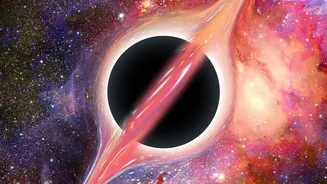
The researchers describe this hypothetical event using a quirky term: a 'pair-of-pants topology'. Imagine the event horizon, the black hole's boundary, tracing a shape through spacetime. If it were to split, it would look like a single tube branching into two 'legs', resembling a pair of trousers. However, even with this theoretical possibility, the conditions are extraordinarily strict. The original black hole would need to be rotating at or very near its maximum possible physical speed. Any slower, and the two newly formed black holes wouldn't be able to separate far enough or fast enough to avoid immediately falling back together and merging again. This requirement makes the window for a potential split extremely narrow.
Why This Research Matters
It is crucial to emphasize that this is purely theoretical work; no black hole split has ever been observed. So, why is it significant? This research pushes the boundaries of our understanding of gravity and the extreme physics that govern black holes. By exploring the absolute limits of these cosmic objects, scientists can probe for cracks in Einstein's theory of general relativity and search for clues that might lead to a more complete theory of quantum gravity. The researchers suggest that while large, astrophysical black holes are unlikely candidates for splitting, smaller, hypothetical primordial black holes formed in the early universe might be more prone to such a process. According to one of the study's authors, Francesco Sannino, it may even be possible to indirectly detect such an event by searching for gamma-ray signals from tiny fragments.