


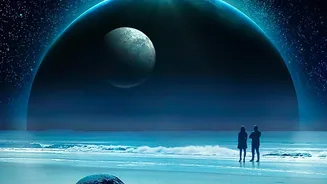

A Cosmic Colour Filter
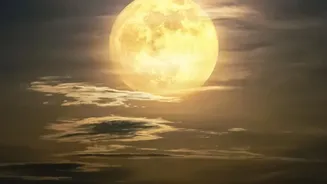
First, let's talk about that warm, orange glow. The colour change isn't an illusion; it's real physics at work. The phenomenon responsible is called Rayleigh scattering, the very same reason the sky is blue and sunsets are red. When the moon is low on the horizon,
its light has to travel through a much thicker slice of Earth's atmosphere to reach your eyes. This dense layer of air is filled with tiny molecules that are better at scattering short-wavelength light, like blues and violets. They effectively filter these cooler colours out, allowing the longer wavelengths of light—the reds, oranges, and yellows—to pass straight through to you. The result is that the moon, and the sun for that matter, appears much redder when it is rising or setting.
The Great Moon Deception
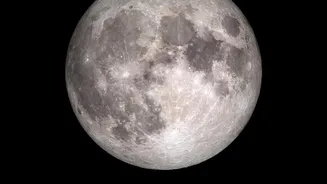
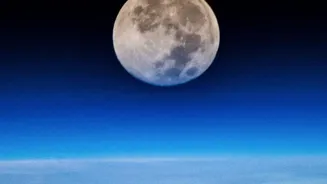
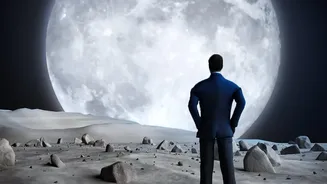
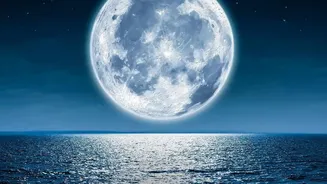
Now for the big question: why does the moon look so enormous? Unlike the colour change, this is purely an optical illusion. If you were to measure the moon with a camera or even just hold a coin at arm's length to cover it, you'd find it's the exact same size on the horizon as it is high in the sky. In fact, due to the geometry of your position on Earth, the horizon moon is technically slightly farther away from you than the overhead moon, so it should appear marginally smaller, not larger. The fact that it looks bigger is a powerful trick your brain is playing on you, and scientists refer to it as the 'Moon Illusion'.
Your Brain Is The Culprit
While there isn't one single, universally accepted explanation, the leading theory involves context and how our brains perceive distance. It's often linked to something called the Ponzo illusion. Imagine two identical lines drawn on a set of converging railway tracks. The line drawn 'farther away' where the tracks appear closer together will look longer to your brain. Your brain is hardwired to understand that objects on the horizon are farther away than objects overhead. When it sees the moon near the horizon, surrounded by familiar reference points like trees, buildings, and mountains, it assumes the moon is very far away. Since the image of the moon on your retina is still the same size, your brain concludes that for it to look that size from so 'far away', it must be physically massive.
An Empty Sky and a Shrinking Moon
When the moon is high in the sky, those terrestrial reference points are gone. It’s just a bright disc floating in a vast, empty expanse of black. Without any objects to compare it to, your brain has no sense of scale or depth. Lacking the contextual clues of the horizon, your brain perceives the overhead sky as being 'closer' than the distant horizon. As a result, it sees the moon for what it is: a relatively small object in your field of view. The illusion vanishes, and the moon appears to 'shrink' back to its normal size, even though it hasn't changed at all. The entire spectacle is a powerful demonstration of how our perception is not a perfect mirror of reality, but an interpretation of it.
Prove It To Yourself
You don't have to take science's word for it; you can easily prove the Moon Illusion is just that—an illusion. One of the simplest ways is to hold a small object, like a 10-rupee coin, at arm's length when the moon looks enormous on the horizon. You'll find the coin can easily cover it. Wait a few hours for the moon to climb higher in the sky, where it appears smaller. Hold the coin out again at the same arm's length. You’ll see that it still covers the moon just as easily. Another quirky method is to bend over and look at the horizon moon from between your legs. By viewing it from an unfamiliar perspective, you strip away your brain's usual processing, and the illusion often disappears instantly.