



Introducing Shukrayaan: India’s Next Great Space Leap
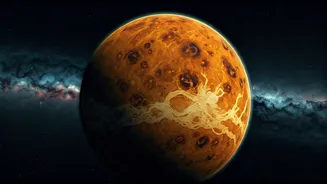
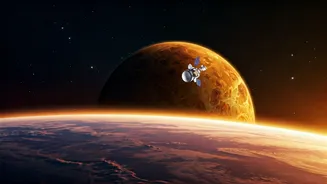
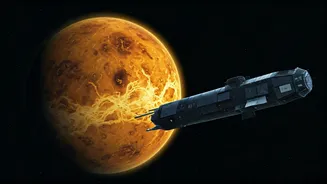
Following the historic successes of its Mars and Moon missions, ISRO is turning its attention to the brightest object in our night sky after the Moon: Venus. Officially named the Venus Orbiter Mission, and popularly known as Shukrayaan-1 (from the Sanskrit
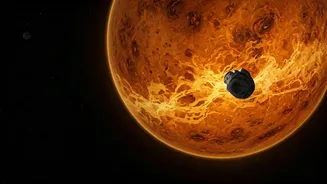
words for Venus and craft), this is India's first dedicated mission to our neighbouring world. Formally approved by the Indian government in September 2024, the mission represents a major step in the nation's planetary exploration ambitions. The launch is slated for March 2028, with the spacecraft embarking on a journey of over 100 days to reach its destination. The mission aims to place India in an elite club of nations that have successfully studied Venus up close, deepening our understanding of how planets evolve.
A Tale of Two Planets
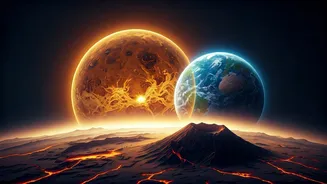
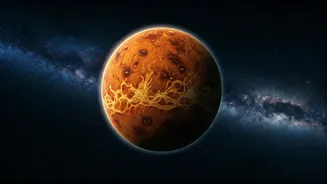
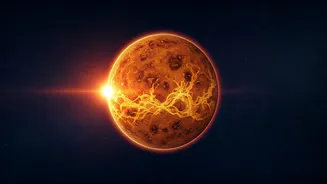
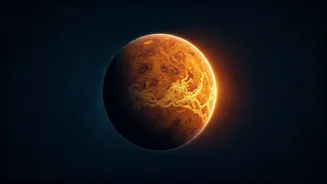
Venus is often called Earth’s twin, and for good reason. The two planets are remarkably similar in size, mass, and density, and were formed from similar materials in the same part of the solar system. But the similarities end there. Venus is a hellscape, boasting surface temperatures hot enough to melt lead, an atmosphere 90 times thicker than Earth's, and clouds of sulfuric acid. Its surface pressure is equivalent to what you’d feel nearly a kilometre deep in our oceans. So, what went wrong? Scientists believe that billions of years ago, Venus may have been more like Earth, possibly with liquid water oceans. Understanding this dramatic divergence is the key scientific mystery that Shukrayaan-1 aims to solve.
The Runaway Greenhouse Effect: A Warning from Venus
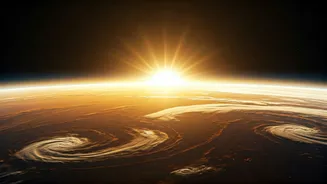
The core of Venus's story is a climate catastrophe known as the 'runaway greenhouse effect'. The theory suggests that as the young Sun grew hotter, any oceans on Venus began to evaporate, filling the atmosphere with water vapour—a potent greenhouse gas. This trapped more heat, which caused more evaporation, creating a devastating feedback loop. Eventually, the oceans boiled away completely. High in the atmosphere, solar radiation would have split the water molecules, with the light hydrogen escaping into space, ensuring the water was lost forever. The planet’s carbon dioxide, which on Earth is largely locked away in rocks and oceans, remained in the atmosphere, creating the crushing, superheated environment we see today. By studying this process, Shukrayaan will provide invaluable data for modelling Earth’s own climate and the potential tipping points we face.
Peering Beneath the Clouds
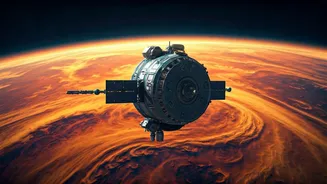
So how will ISRO study a planet permanently shrouded in thick clouds? The Shukrayaan orbiter will be equipped with a suite of sophisticated instruments designed to see the unseen. The mission's flagship instrument is a high-resolution Synthetic Aperture Radar (SAR), which can penetrate the dense clouds to map the planet’s surface in detail, looking for evidence of volcanic activity and other geological features. In a global first, the mission will also carry a ground-penetrating radar to study the shallow subsurface of Venus, something no mission has done before. Other instruments, developed with international partners from Sweden, France, and Russia, will analyze the atmospheric composition, study its strange 'super-rotation', and examine how the solar wind interacts directly with the Venusian atmosphere in the absence of a planetary magnetic field.
Why This Mission Matters for India
For India, the Venus Orbiter Mission is more than just a scientific endeavour; it is a statement of intent. Building on the low-cost, high-success model of the Mars Orbiter Mission (Mangalyaan), Shukrayaan-1 reinforces ISRO’s reputation for executing complex interplanetary missions efficiently. The mission will not only yield a treasure trove of data for scientists worldwide but will also inspire a new generation of engineers and researchers in India. As humanity looks to understand our place in the cosmos and the fragility of our own planet, ISRO's journey to Venus will be a critical chapter in that story, providing a unique perspective on the life and death of habitable worlds.