





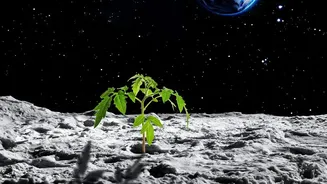

The Billion-Dollar Lunchbox
For any long-duration mission to Mars, resupplying astronauts with food from Earth is simply not feasible. The cost, weight, and transit time—a one-way trip takes six to nine months—make it a logistical nightmare. Furthermore, pre-packaged meals lose
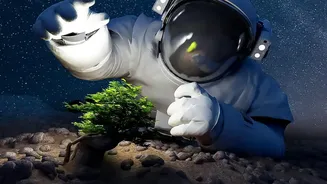
nutritional value and taste over time. The only viable solution for a sustainable human presence on the Red Planet is to grow food locally. This turns agriculture from a terrestrial practice into a critical component of space technology. NASA and other space agencies are actively researching bioregenerative life support systems, where plants not only provide food but also produce oxygen, purify water, and recycle waste.
Students Take on the Red Dirt
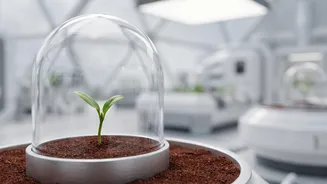
While NASA runs sophisticated experiments like the Veggie and Advanced Plant Habitat systems on the International Space Station, some of the most creative research is happening in university labs. For example, a project by three Texas students called 'Gaia's Outpost' recently won an award for its design to process toxic Martian soil and make it farmable. Their concept aims to create a system where astronauts can produce fresh food, which also provides psychological benefits by introducing greenery into a barren habitat. Other student projects, like the 'Red Thumbs Mars Garden Project' at Villanova University, have experimented with growing crops like sweet potatoes and lettuces in simulated Martian soil, known as regolith.
The Trouble with Martian 'Soil'
Farming on Mars is far more complex than the film 'The Martian' suggested. Mars isn’t covered in soil as we know it; it’s covered in regolith, which is essentially crushed rock and dust with no organic matter. This regolith presents several major hurdles. Firstly, it is toxic to most plants due to the presence of perchlorate salts. Secondly, it lacks essential nutrients for plant growth, most notably nitrogen. Earth soil is a living ecosystem of microbes that process waste and make nutrients available, a feature entirely absent on Mars. Recent experiments have shown that the more accurately a simulated regolith mimics Mars's true chemical makeup, the harder it is for plants to survive in it.
Detoxifying the Dirt
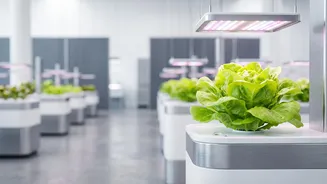
To turn Martian regolith into a viable growth medium, scientists are exploring a multi-step process. One promising idea is to use microbes from Earth that actually consume perchlorates as food, detoxifying the soil while releasing oxygen as a byproduct. After detoxification, the regolith would need to be enriched. This could involve adding organic matter from composted crop waste or human biowaste, as well as introducing nitrogen-fixing bacteria to create a more fertile, living soil. Other proposed solutions bypass soil entirely, focusing on hydroponic or aquaponic systems. A project at the University of Greenwich is studying how fish waste could provide nutrients to grow vegetables in a Martian environment, creating a closed-loop food system.
From Student Concepts to Space Missions
While student projects like Gaia's Outpost are still concepts, they represent the foundational thinking required for future missions. They tackle the same problems that organizations like NASA are working on with systems destined for space, such as the Ohalo III prototype crop system scheduled for testing on the ISS. These smaller experiments, whether testing aquaponics, bacteria, or different crop types, are crucial for gathering data and refining the technologies that will one day feed a Martian colony. They prove that the first farmers on Mars won't just be astronauts; they'll be scientists and engineers who solved one of space exploration's most fundamental challenges back on Earth.