







A Sweet Discovery in Deep Space
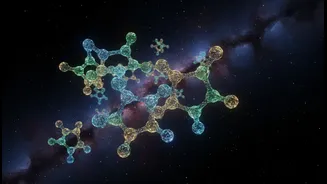
Astronomers have detected a specific type of sugar, known as erythrulose, for the first time in interstellar space. This four-carbon sugar, which on Earth is found in things like raspberries and is used in some self-tanning products, was spotted in a dense
molecular cloud named G+0.693-0.027. This cloud is located about 26,700 light-years away, near the turbulent center of our Milky Way galaxy. Using highly sensitive radio telescopes in Spain and France, an international team of researchers identified the unique spectral fingerprint of erythrulose molecules swirling in the gas and dust. While other sugar-related molecules have been found on meteorites, this is the first time a true sugar has been directly identified in the vast expanse between star systems.
What Are Prebiotic Molecules?
Prebiotic molecules are the chemical ingredients necessary for life to begin. They are not life itself, but rather the non-living organic compounds that, under the right conditions, can assemble into more complex structures like RNA, DNA, and proteins. Think of them as the basic Lego bricks of biology. Sugars are a critical component of this cosmic construction set. They serve as energy sources and, most importantly, form the structural backbone of the nucleic acids that carry genetic information. For decades, a major puzzle in origin-of-life research has been how these essential sugars could have formed in sufficient quantities on early Earth, as lab simulations of our planet's primordial conditions have struggled to produce them efficiently. This new discovery adds weight to the theory that these ingredients might not have been made on Earth, but delivered from space.
Why Erythrulose Is a Key Player
The detection of erythrulose is particularly exciting because of its complexity. With four carbon atoms, it represents a step up on the ladder of chemical complexity from the simpler molecules previously found. The discovery was also surprising because researchers found that erythrulose was at least eight times more abundant in the cloud than any three-carbon sugars, which were expected to be more common. This challenges the long-held theory that complex molecules in space form by adding one carbon atom at a time. Instead, it appears erythrulose forms on the icy surfaces of dust grains by combining simpler two-carbon molecules. This molecule, while not directly part of our DNA, can be easily converted into related sugars that are believed to be precursors to the first genetic polymers on Earth.
The Cosmic Factory for Life's Ingredients
Giant molecular clouds like Sagittarius B2 and G+0.693-0.027 act as colossal chemical factories. These dense, cold regions are nurseries for new stars and planets, and their icy dust grains provide the perfect surfaces for simple atoms and molecules to meet and react, forming more complex structures. Over millions of years, bombarded by cosmic rays, these simple ingredients build up into an impressive inventory of organic compounds. Scientists have now identified hundreds of different molecules in these clouds, ranging from simple alcohols to the building blocks of proteins and, now, complex sugars. This rich chemistry floating between the stars suggests that the raw materials for life are not rare, but a common feature of the galaxy.
Connecting the Stars to Ourselves
If these life-giving ingredients are being mass-produced in space, how did they get here? The leading theory is that they were delivered to a young Earth during a period known as the Late Heavy Bombardment, about 4 billion years ago. During this chaotic time, comets and asteroids, rich with the organic molecules they collected from the primordial cloud that formed our solar system, would have frequently slammed into our planet. Researchers estimate that millions of tonnes of erythrulose could have arrived on Earth's surface this way. This cosmic delivery would have supplied the planet with a vital stockpile of prebiotic materials, potentially kick-starting the chemical reactions that ultimately led to the first living organisms. This discovery strengthens the idea that life on Earth has deep cosmic roots.