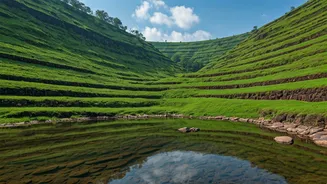










Why the Ghats Matter
The Western Ghats, a UNESCO World Heritage Site, is one of the world's eight 'hottest hotspots' of biological diversity. These mountains influence the Indian monsoon and give rise to major rivers that sustain millions. However, this fragile ecosystem
is under severe stress from deforestation, unregulated construction, mining, and the pressures of a growing population. The consequences are stark, including habitat fragmentation, increased human-wildlife conflict, and a greater risk of landslides, exacerbated by climate change.
The Debate Over Protection
For over a decade, a debate has raged on how best to protect this vital region. The 2011 Madhav Gadgil committee report recommended a stringent, holistic approach, calling for the entire Ghats to be declared an ecologically sensitive area with strong local community involvement in governance. However, this faced opposition from states concerned about economic development. A subsequent report by the Kasturirangan committee in 2013 proposed a more moderate approach, suggesting that only about 37% of the Ghats be classified as an Ecologically Sensitive Area (ESA), distinguishing between 'natural' and 'cultural' landscapes (areas with human settlements). The central government has since been working to notify ESAs based largely on the Kasturirangan report, attempting to balance conservation and development.
A Blueprint for Smart Planning
Achieving 'Green Ghats' is not about halting development but about guiding it intelligently. Smart planning is the essential bridge between conservation and human needs. This involves a multi-pronged strategy that respects the region's ecological limits while empowering its inhabitants.
Empowering Local Communities
True conservation is impossible without the involvement of the people who live in and depend on the Ghats. Indigenous and local communities possess invaluable traditional knowledge about their ecosystems. A cornerstone of smart planning is to empower these communities through Biodiversity Management Committees and other local bodies, giving them a decisive role in conservation and ensuring they benefit from it. This approach, rooted in the Biological Diversity Act, 2002, turns residents into guardians of their environment, a model that has proven successful in various community conservation areas across India.
Sustainable Livelihoods and Tourism
Unchecked commercial activity can be disastrous, but sustainable livelihoods can be a force for good. Promoting eco-friendly agriculture like organic farming and agroforestry helps maintain soil health and biodiversity. Similarly, responsible eco-tourism offers a powerful alternative to destructive, large-scale construction. Models in states like Kerala and Sikkim show that community-owned homestays, guided nature walks, and cultural experiences can create economic value while preserving the natural landscape. This model focuses on low-impact, high-value experiences that benefit local economies directly.
Data-Driven Regulation and Monitoring
Effective planning relies on solid data. Using modern tools like satellite imagery, GIS mapping, and drone surveillance can help scientifically identify and demarcate Ecologically Sensitive Zones (ESZs). These zones act as buffer areas around protected national parks and wildlife sanctuaries, with clear rules on what activities are prohibited, regulated, or permitted. This data-driven approach allows for better enforcement against illegal mining, quarrying, and deforestation, ensuring that development does not encroach upon the most fragile areas.