






A Twist in the Universe’s Oldest Light
Imagine light travelling across the entire observable universe for 13.8 billion years. According to our standard model of cosmology, its path should be straight and true. But some theories predict that something strange might happen along the way: the very
fabric of spacetime could cause the light's orientation, or polarization, to rotate. This theoretical phenomenon is called cosmic birefringence. If detected, it would be like finding out that the universe has a subtle 'handedness', preferring one direction over another. This would violate a fundamental symmetry of physics called parity, which states that the laws of physics should be the same for a process and its mirror image. While the weak nuclear force is known to violate parity, finding such a violation on a cosmological scale would be a revolutionary discovery, pointing to new, undiscovered particles or forces.
Listening to the Big Bang's Echo
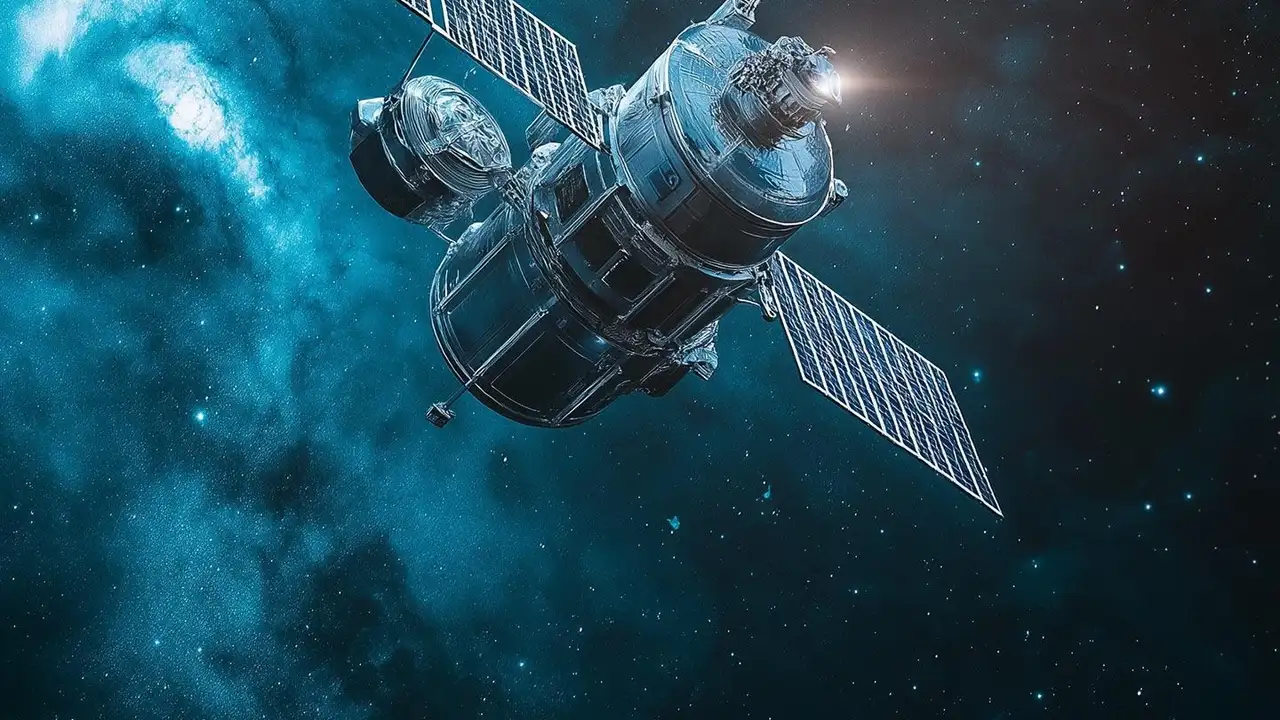
To hunt for this tiny twist, scientists look at the oldest light in the cosmos: the Cosmic Microwave Background (CMB). The CMB is the afterglow of the Big Bang, a faint microwave radiation that fills all of space, providing a snapshot of the universe when it was just 380,000 years old. The European Space Agency's Planck satellite, which operated from 2009 to 2013, created the most detailed map of the CMB to date. A tiny fraction of this ancient light is polarized, meaning it vibrates in a preferred direction after its last interaction with matter in the early universe. By studying the orientation of this polarized light, researchers can search for any rotation that occurred during its epic journey to Earth.
A Tantalizing but Tricky Signal
Recent analyses of data from Planck, as well as ground-based experiments like the Atacama Cosmology Telescope (ACT), have found intriguing hints of a small, non-zero rotation angle. Several studies in 2026, combining data from both Planck and ACT, have reported a consistent signal with a statistical significance that is growing harder to ignore. One joint analysis reported a potential signal with a significance of over 4 sigma, a level that gets scientists very excited, though it still falls short of the 5-sigma gold standard for a confirmed discovery. However, the search is incredibly difficult. The potential signal is minuscule, and researchers must carefully account for all possible sources of error. The biggest challenge is distinguishing a true cosmic signal from contamination by our own Milky Way galaxy, whose dust also emits polarized light, and from tiny, hard-to-measure calibration errors in the telescopes themselves.
Beyond the Standard Model
So why is this faint signal so important? Because the Standard Model of cosmology, our current best explanation for the universe (also known as the Lambda-CDM model), does not predict cosmic birefringence. Its detection would be concrete evidence of physics beyond this model. Scientists believe this effect could be caused by new, extremely light particles, such as axions, which are leading candidates for dark matter. It could also be linked to the mysterious dark energy that is causing the expansion of the universe to accelerate. Confirming that the universe's oldest light has been twisted would not just be a curious anomaly; it would open a brand-new window into understanding the 95% of the cosmos that remains dark and unexplained.
What Comes Next?
The scientific community is buzzing with cautious optimism. The consistent hints from independent datasets are compelling, but researchers emphasize that more work is needed to rule out all systematic errors. New techniques are being developed to better calibrate the instruments and subtract the foreground glow from our galaxy. Future, more sensitive CMB experiments, such as the Simons Observatory and the LiteBIRD satellite, are being designed to probe this phenomenon with even greater precision. These upcoming observations will be crucial in determining whether the detected signal is a persistent systematic error or, as many hope, the first glimpse of a fundamental new aspect of our universe. The hunt is on, and the legacy data from Planck continues to be at the very center of the search.