






Meet the Warm Neptunes
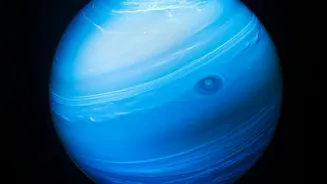
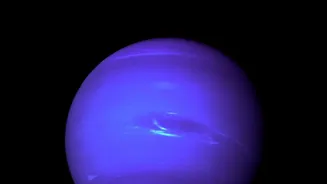
Imagine a planet similar in size to our own Neptune or Uranus, but orbiting much closer to its star. These are 'warm Neptunes,' a relatively rare category of exoplanet. Unlike the ice giants in our solar system's frigid outer suburbs, these worlds are heated
by their parent stars, though they are not as scorching as the 'hot Jupiters' that live even closer. Recent studies have focused on planets like WASP-80 b and TOI-199b, worlds hundreds of light-years away that offer a new laboratory for understanding how planets form and evolve. The James Webb Space Telescope (JWST) has been instrumental, using its powerful infrared vision to peer into the chemical makeup of their skies. Until recently, methane had been surprisingly elusive in the atmospheres of these transiting exoplanets.
The Significance of Methane
Finding methane is a landmark event for astronomers. On Earth, the vast majority of methane is produced by living organisms, making it a tantalising potential 'biosignature' in the search for extraterrestrial life. However, methane can also be produced by non-biological processes, such as volcanic activity or reactions involving water and rock. Therefore, its presence alone isn't proof of life. On a gas giant like a warm Neptune, life as we know it is not expected. The true significance here is what methane tells us about the planet's chemistry and history. Its presence or absence helps scientists piece together the puzzle of how and where the planet formed. By measuring the ratio of methane to other gases like water, astronomers can infer the planet's carbon-to-oxygen ratio, a key clue to whether it formed close to its star or migrated inward from a colder region.
How the Telescope Finds the Gas
Detecting a specific gas from hundreds of light-years away is a monumental technological feat. The James Webb Space Telescope accomplishes this using a technique called transmission spectroscopy. As an exoplanet passes in front of its host star from our point of view—an event called a transit—a tiny fraction of the starlight filters through the planet's atmosphere. Different gas molecules absorb specific wavelengths, or colours, of light. Methane, for instance, blocks a particular part of the infrared spectrum. By analysing the starlight that reaches the telescope, scientists can see which wavelengths are missing and deduce the presence of specific gases like methane, carbon dioxide, and water vapour. This method allows for a detailed chemical census of worlds we can never hope to visit directly.
A Richer Atmospheric Picture
The latest findings are about more than just one gas. On planets like WASP-107b, scientists have detected a cocktail of chemicals including methane, water, carbon dioxide, and even sulphur dioxide. This rich dataset allows for much more detailed modelling of the planet’s atmosphere and interior. For instance, the amount of methane detected on WASP-107b was far lower than what chemical models predicted, suggesting that vigorous mixing in the atmosphere, dredging up hotter gases from deep within the planet, is disrupting the expected chemical balance. This tells astronomers that the planet's interior is hotter and more active than previously thought. The presence of these combined gases confirms long-held theories about the composition of temperate gas giants and helps refine models for how planetary atmospheres evolve over time.
Expanding Our Cosmic Search
While these warm Neptunes are not candidates for life, these discoveries are a crucial stepping stone. Understanding the full range of planetary environments, including those without life, provides the context needed to correctly interpret potential biosignatures on other worlds. If we find methane on a small, rocky planet in its star’s habitable zone, knowing how methane behaves on a gas giant helps us rule out false positives. Each detection on a world like WASP-80 b or TOI-199b allows for an 'apples-to-apples' comparison with the giants in our own solar system, testing and improving our universal models of planet formation. It confirms that the JWST is capable of making these sensitive detections, paving the way for future telescopes designed specifically to hunt for signs of life.