



The Runaway Universe
Imagine throwing a ball into the air. You expect gravity to slow it down, eventually causing it to fall back to Earth. For most of the 20th century, cosmologists expected the same for the universe. They reasoned that the gravitational pull of all the matter
within the cosmos would gradually slow down the expansion that began with the Big Bang. They even debated whether there was enough matter to eventually halt and reverse the expansion in a “Big Crunch”. But in 1998, two separate teams of astronomers made a startling discovery while observing distant exploding stars, or Type Ia supernovae. These supernovae act as “standard candles” because they have a consistent intrinsic brightness, allowing scientists to calculate their distance. The observations showed these distant objects were dimmer—and therefore farther away—than they should be. The only explanation was that the expansion of the universe wasn't slowing down; it had started accelerating roughly five billion years ago. This discovery, which earned its leaders a Nobel Prize, opened up one of the biggest questions in modern physics.
Prime Suspect: Dark Energy
To explain this cosmic acceleration, scientists proposed the existence of a mysterious, repulsive force that counteracts gravity. They named it “dark energy”. According to the prevailing cosmological model, known as Lambda-CDM, dark energy makes up a staggering 68% of the universe's total mass-energy content. The simplest explanation for dark energy is the “cosmological constant,” an idea Albert Einstein first proposed to create a static universe and later called his “biggest blunder.” In this view, dark energy is an intrinsic property of space itself—a form of vacuum energy that pushes everything apart. Another idea, called quintessence, suggests dark energy is a dynamic field that can change over time and space, unlike a constant. While the dark energy theory fits observations well, it comes with a major theoretical headache: quantum field theories predict a vacuum energy that is about 120 orders of magnitude larger than what we observe, a discrepancy that has been called the worst prediction in the history of physics.
Alternative Theory: Modified Gravity
What if the problem isn't a missing energy, but a misunderstanding of the rules? A competing set of theories suggests that dark energy doesn't exist at all. Instead, they propose that Einstein's theory of general relativity, our current best description of gravity, breaks down on cosmological scales. These “modified gravity” theories suggest that gravity behaves differently over vast distances than it does within our solar system. If gravity were weaker over cosmic scales, it could explain why the universe's expansion is accelerating without the need for a mysterious repulsive force. Testing these ideas is incredibly difficult, as any new theory of gravity must also perfectly explain the motions of planets and stars where general relativity has been proven remarkably accurate. However, the possibility remains that what we perceive as dark energy is actually the first sign that our fundamental theory of gravity needs an upgrade.
The Detective: Enter the Roman Space Telescope
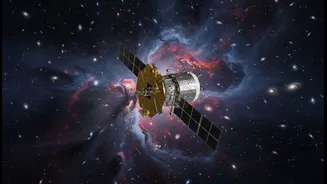
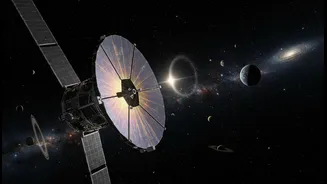
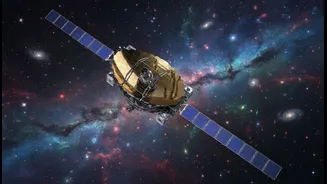
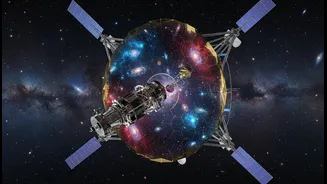
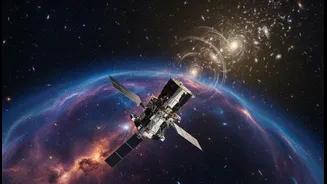
This is where the Nancy Grace Roman Space Telescope comes in. Scheduled to launch around late 2026, Roman is NASA's next great observatory, designed specifically to tackle the dark energy puzzle. Named after NASA's first chief of astronomy, Nancy Grace Roman, the telescope has a 2.4-meter primary mirror, the same size as Hubble's, but with a critical difference: its Wide Field Instrument gives it a field of view 200 times larger than Hubble’s infrared camera. This panoramic vista will allow Roman to map vast swathes of the sky with incredible speed and detail, creating unprecedented 3D maps of the universe. By surveying billions of galaxies and thousands of distant supernovae, Roman will gather the precise data needed to distinguish between the competing explanations for cosmic acceleration.
Cosmic Forensics in Action
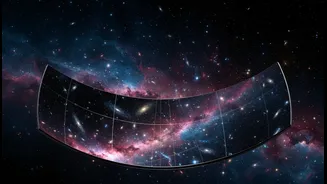
Roman will employ multiple strategies to conduct its investigation. Its High-Latitude Wide-Area Survey will map the positions and distances of millions of galaxies, looking for patterns in their distribution called baryon acoustic oscillations—imprints left over from the early universe that serve as a cosmic ruler. The telescope will also conduct a massive survey using weak gravitational lensing, measuring how the light from distant galaxies is subtly distorted by the gravity of matter in the foreground. This will reveal how large-scale structures in the universe have grown over time, a process sensitive to the push and pull of dark energy and gravity. Finally, Roman's High-Latitude Time-Domain Survey will discover thousands of new Type Ia supernovae, extending the measurements that first revealed the acceleration to much greater distances and with far better precision. By combining these different lines of evidence, scientists can check for consistency and see if the data points toward an invisible energy or a new law of physics.