

Seeing the Unseen in Infrared
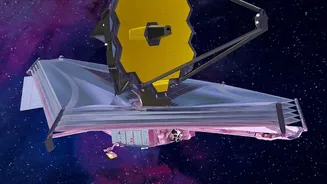
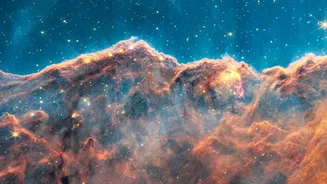
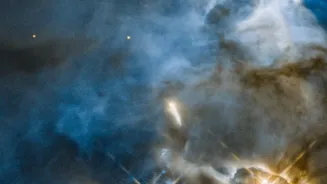
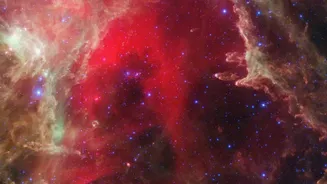
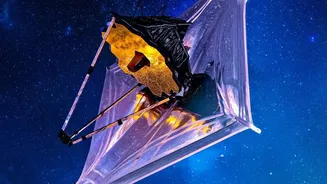
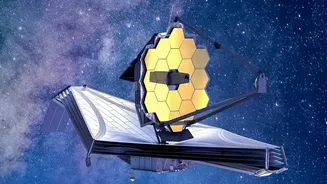
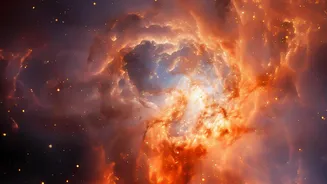
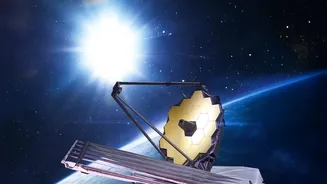
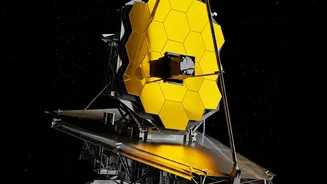
To understand what the James Webb Space Telescope (JWST) is revealing, it helps to know how it sees. Stellar nurseries are vast, cold clouds of gas and dust. While beautiful, this dust acts like a thick fog, blocking visible light and hiding the young
stars forming within. JWST, however, is designed to detect infrared light. This longer wavelength of light can penetrate the dust clouds, allowing astronomers to witness processes that were previously invisible. This unique capability is like having a superpower that lets us peer inside cosmic cocoons, transforming our understanding of these active star-forming regions. By capturing the faint infrared glow from molecules and infant stars, Webb is essentially conducting a chemical survey of these hidden environments.
A Surprising Chemical Cocktail
One of Webb's most exciting discoveries is the sheer complexity of molecules present in these nurseries. Astronomers have found a rich assortment of what are known as complex organic molecules (COMs) — carbon-based compounds that are precursors to the building blocks of life. In various protostars, Webb has identified molecules like acetaldehyde, ethanol (the alcohol in beverages), methyl formate, and even acetic acid, the component that gives vinegar its sour taste. These aren't just random chemicals; they are key ingredients for forming potentially habitable worlds. Their presence in icy form, clinging to dust grains, suggests that these vital compounds could be incorporated into comets and asteroids, which later deliver them to newly forming planets.
The Orion Nebula's Carbon Keystone
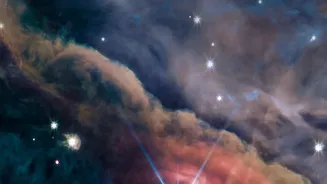
In the famous Orion Nebula, about 1,350 light-years away, Webb made a landmark detection: the methyl cation (CH3+). This molecule, a simple compound of carbon and hydrogen, had been theorized to be a cornerstone of interstellar organic chemistry for decades, but it had never been detected outside our solar system until now. The methyl cation is highly reactive and helps initiate chains of chemical reactions that build even more complex carbon-based molecules. Its discovery in the protoplanetary disk of a young star confirms its central role in the chemical evolution of star-forming regions. Interestingly, the intense ultraviolet radiation from nearby massive stars, once thought to be destructive to molecules, may actually provide the energy needed for CH3+ to form, showcasing how these environments are far more dynamic than previously believed.
Rethinking Star and Planet Formation
These chemical inventories are reshaping theories of how stars and planets come to be. For instance, observations have revealed a wealth of carbon-containing molecules like ethane and benzene around very low-mass stars, suggesting that any planets forming there might develop hydrocarbon-rich atmospheres, very different from early Earth. Webb has also provided an in-depth inventory of ices in the coldest, darkest parts of molecular clouds, finding frozen water, methane, ammonia, and methanol. These ices are the primary carriers of key elements like carbon, hydrogen, oxygen, and nitrogen needed for life. By tracking how these ices turn to vapor as they get closer to a young star, scientists can better model how a rich environment for Earth-like planets is created.
The Search for Our Cosmic Origins
Ultimately, every molecule Webb detects is a clue in the grand mystery of our own origins. By studying the chemistry of stellar nurseries, we are essentially looking at the starting conditions for planetary systems across the galaxy. Discovering complex organic molecules in the Large Magellanic Cloud, a neighboring galaxy with a different chemical environment, shows that the building blocks of life are not unique to the Milky Way. The detection of water and silicate dust—a key component of rocks—surviving in the harsh environment near our galaxy's central black hole further proves that the ingredients for planets can exist even in the most extreme places. While Webb has not found life, it is proving that the raw materials are abundant, providing a deeper understanding of how a galaxy can build habitable worlds.