



The 'Zero Gravity' Misconception
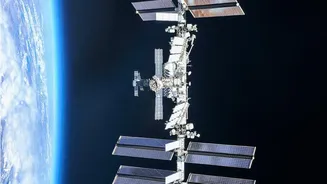
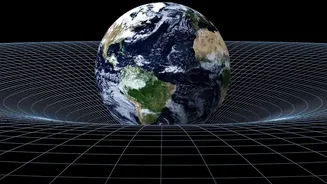
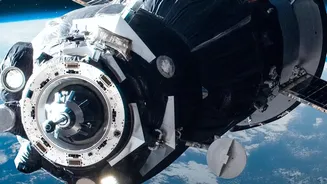
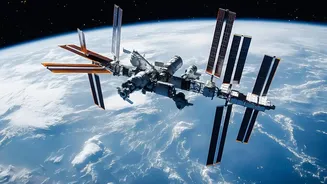
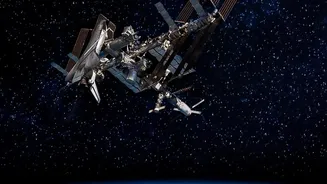
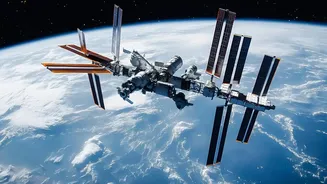
First, let's clear up the biggest myth: there is no such thing as 'zero gravity' in Earth's orbit. It’s a catchy phrase, but it’s scientifically inaccurate. The International Space Station (ISS) orbits at an altitude of about 250 miles (or 400 kilometers).
At that height, Earth's gravitational pull is still surprisingly powerful—about 90% as strong as it is on the surface. If you could build a ladder to the station and stand on a scale, a 180-pound person would still weigh about 162 pounds. So, if gravity is still firmly in charge, why does everything float?
The Real Secret: It's All About Speed
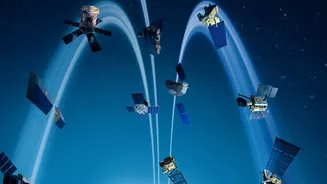
The feeling of weightlessness isn't caused by a lack of gravity but by an immense amount of sideways speed. To stay in orbit, the ISS hurtles along at a staggering 17,500 miles per hour. Isaac Newton imagined this concept with a thought experiment about a cannon on a very tall mountain. If you fire a cannonball, it travels some distance before gravity pulls it to the ground. If you fire it much faster, it travels farther before landing. But if you could fire it at exactly the right speed—orbital velocity—the cannonball would fall toward Earth, but the planet's surface would curve away beneath it at the exact same rate. It would perpetually fall, but never land. This is precisely what an orbit is.
A State of Constant Freefall
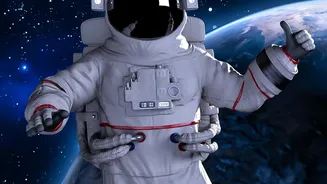
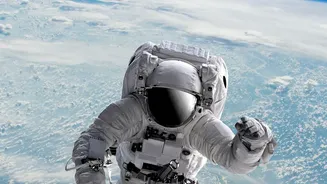
This leads to the core of the answer: astronauts feel weightless because they are in a constant state of freefall. Everything inside the ISS—the astronauts, their equipment, the air they breathe—is falling toward Earth at the exact same rate as the station itself. Think of it like being in an elevator when the cables snap. For the few terrifying seconds you are falling, if you were to let go of your phone, it would float in front of you. You, the phone, and the elevator car are all falling together. Astronauts are simply in an elevator that's also moving sideways so fast that it never hits the ground. Because nothing is pushing back up on them, they feel no weight.
Weight vs. Mass
This highlights the crucial difference between mass and weight. Your mass is the amount of 'stuff' you are made of, and it never changes (unless you go on a diet). Your weight is the force that gravity exerts on your mass. On Earth, you feel your weight because the ground pushes back up on you, creating a compressive force. In orbit, an astronaut's mass is unchanged, but since they are falling freely without any opposing force, they have no sensation of weight. This is why scientists prefer the term 'microgravity' over 'zero-g'. It acknowledges that gravity is still present, but its effects, like the sensation of weight, are not apparent. Tiny residual forces from atmospheric drag and crew movements mean the environment isn't perfectly 'zero-g', but rather a state of near-perfect weightlessness.