



A Deluge of Debris
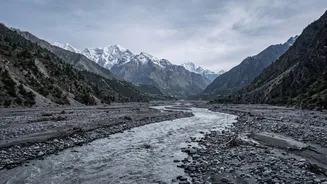
On the night of June 15, 2021, the Melamchi River, a vital water source for communities in the Sindhupalchok district, transformed into a violent torrent. It wasn't just water; the flood was a thick, churning slurry of mud, boulders, and logs that surged
downstream. It inundated Melamchi Bazaar, destroyed homes, swept away bridges, and severely damaged the headworks of the country's largest drinking water project. The disaster displaced more than 600 people and resulted in numerous casualties, leaving a landscape scarred by immense deposits of sediment and a community in shock. A second, equally severe flood struck again in late July, compounding the devastation.
An Unfolding Geological Mystery
In the immediate aftermath, the cause of the disaster was not obvious. Early theories pointed towards a Glacial Lake Outburst Flood (GLOF), a common hazard in the Himalayas where a lake formed by a melting glacier suddenly bursts its natural dam. Others suspected that exceptionally heavy monsoon rains had triggered widespread landslides. While rainfall was a factor, the sheer volume of debris and the explosive nature of the flood suggested a more complex and powerful trigger. For months, scientists worked to understand the precise sequence of events, knowing that pinpointing the cause was critical for predicting and mitigating future disasters in this fragile, tectonically active region.
The Avalanche Breakthrough
Using satellite imagery, digital elevation models, and fieldwork, an international team of scientists has now identified the primary culprit: a massive ice-and-rock avalanche high in the mountains. This was not a simple snow slide. A huge, unstable mass of rock, ice, and sediment broke free from a steep mountain slope. These events are particularly dangerous because the presence of ice can drastically increase their speed and the distance they travel. The research, which analyzed landscape changes before and after the event with remarkable precision, showed that the initial collapse occurred in the high-altitude reaches of the valley, far from where the damage was most visible.
A Catastrophic Chain Reaction
The research reveals a classic case of a cascading hazard. The disaster began when the colossal ice-and-rock avalanche slammed into the valley below. This impact likely triggered a landslide that temporarily blocked the Melamchi River, forming a short-lived dam. As heavy monsoon rainfall and snowmelt continued to feed the river, water built up rapidly behind this unstable barrier. When the dam inevitably failed, it released an enormous, energy-packed wave of water and debris. This slurry-like flow had far more erosive power than a normal flood, allowing it to gouge the riverbed and banks, picking up more sediment and boulders as it thundered downstream toward populated areas.
A Warning for the Entire Himalayan Region
The Melamchi disaster is a stark illustration of the growing risks faced by communities across High Mountain Asia, including India. As climate change warms the planet, Himalayan glaciers are melting at an accelerated rate, and permafrost that once held steep slopes together is thawing. This is making the mountains more unstable and increasing the frequency of complex, cascading events like rock-ice avalanches and subsequent floods. These hazards pose a direct threat to downstream populations and critical infrastructure, such as hydropower plants and highways. The findings underscore an urgent need for more advanced monitoring systems that can detect initial signs of instability high in the mountains, providing precious time for early warnings and evacuations.