


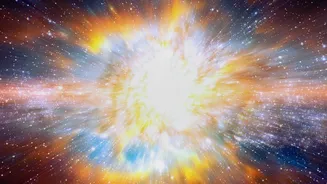
A Celestial Spectacle
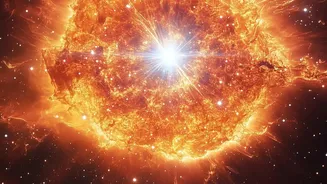
First recorded in Europe on October 9, 1604, the sudden appearance of this intensely bright object in the constellation Ophiuchus caused a stir. At a time when the heavens were believed to be perfect and unchanging, this 'stella nova' or new star presented
a direct challenge to long-held astronomical beliefs. Sky-watchers from Italy to China and Korea documented the event, which remained visible to the naked eye for an astonishing 18 months before finally fading from view in 1606. At its peak, it outshone the planet Jupiter. This event remains the most recent supernova to be definitively observed within our own Milky Way galaxy.
The Observations of Johannes Kepler
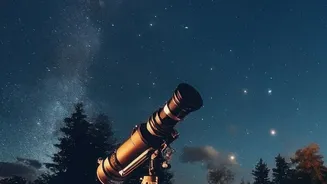
While many observed the celestial visitor, it became inextricably linked with one name: Johannes Kepler. Though not its first discoverer, the German astronomer began a meticulous study of the object from Prague on October 17. Using only his naked eye—the telescope would not be turned to the heavens for another five years—Kepler tracked the star's position and brightness with remarkable precision. He determined it showed no discernible parallax, meaning it was located far beyond the Earth's atmosphere in the realm of the 'fixed stars'. His comprehensive findings were published in his 1606 book, 'De Stella Nova in Pede Serpentarii' ('On the New Star in the Foot of the Serpent Handler'), forever cementing his association with the phenomenon.
What Did They Actually Witness?
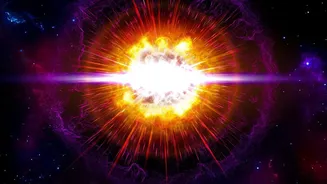
What Kepler and his contemporaries mistook for the birth of a star was actually the cataclysmic death of one. Scientists today understand that SN 1604 was a Type Ia supernova. This specific type of stellar explosion occurs in a binary star system, where two stars orbit each other. The primary actor is a white dwarf—the dense, collapsed core of a once-sunlike star. Over time, the white dwarf's immense gravity pulls material from its companion star. When the white dwarf accumulates enough mass to reach a critical limit, it triggers a runaway thermonuclear explosion that completely obliterates it in a stunningly brilliant blast.
The Remnant in the Modern Era
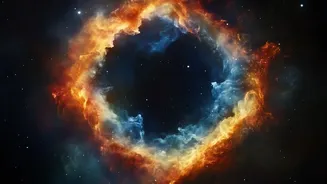
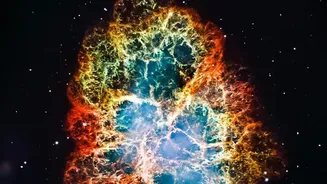
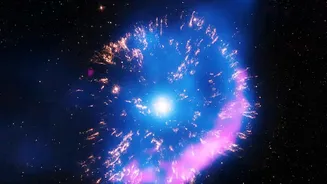
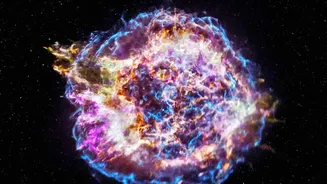
More than 400 years later, the story of Kepler's Supernova continues. In its place, some 20,000 light-years from Earth, lies the Kepler Supernova Remnant—an expanding cloud of gas and dust from the explosion. First identified as a faint nebula in 1941, this cosmic debris field is now a prime target for NASA's Great Observatories: the Chandra X-ray Observatory, the Hubble Space Telescope, and the Spitzer Space Telescope. By combining imagery from different wavelengths of light, astronomers can assemble a complete picture of the remnant. These images reveal a complex, bubble-shaped structure about 14 light-years wide, still expanding outwards at incredible speeds—some knots of material have been clocked at over 20 million miles per hour.
Unlocking the Universe's Secrets
Studying the Kepler remnant provides more than just a spectacular image; it's a cosmic laboratory. The composition of the ejected material helps confirm the event was a Type Ia supernova, as it is rich in iron—an element forged in the heart of the explosion. The shape of the remnant, which is somewhat asymmetrical, suggests the expanding shockwave is colliding with surrounding interstellar gas and dust. By observing how the remnant has expanded over decades, scientists can learn about the environment around the original star system. Because Type Ia supernovae have a predictable peak brightness, they are used as 'standard candles' to measure cosmic distances, helping astronomers to gauge the expansion rate of the universe itself.