



A Storm from the Sun
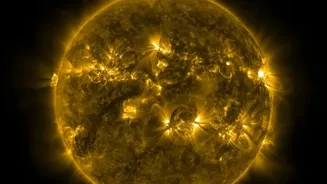
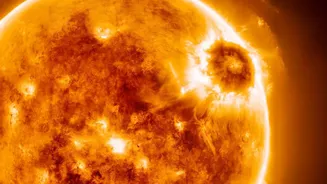
The primary threat comes from something called a Coronal Mass Ejection, or CME. These are enormous eruptions of plasma and magnetic fields from the sun's outer atmosphere, the corona. A single CME can blast billions of tonnes of material into space at speeds
reaching thousands of kilometres per second. While the sun produces CMEs frequently, with several per day during its active periods, most miss our planet entirely. However, when one is aimed at Earth, it becomes a high-stakes race against time. The fastest CMEs can cross the 150-million-kilometre distance to Earth in as little as 15-18 hours, creating what scientists call a solar or geomagnetic storm.
Our Fragile Orbit
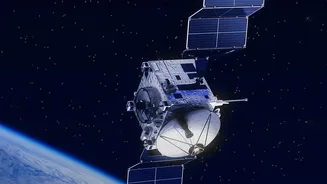
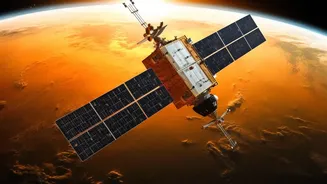
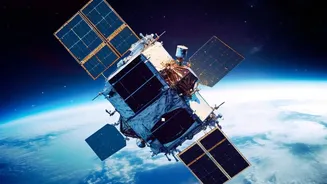
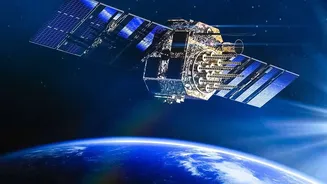
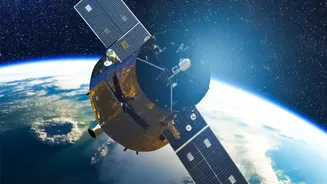
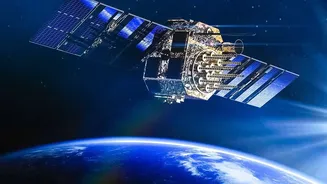
For satellites, a direct hit from a CME is a multi-pronged disaster. The wave of high-energy particles can damage or destroy sensitive electronics, essentially short-circuiting the spacecraft. This is particularly dangerous for satellites in high geosynchronous orbits, where many of our crucial communication systems live. Furthermore, a geomagnetic storm heats and expands Earth's upper atmosphere. This increases the atmospheric drag on satellites in Low Earth Orbit, causing them to slow down, lose altitude, and potentially de-orbit prematurely, as seen in the loss of 38 commercial satellites in February 2022. The economic stakes are immense, with a severe storm threatening trillions of dollars in global economic losses through disruptions to power grids, navigation, and financial systems.
The Digital Weatherman
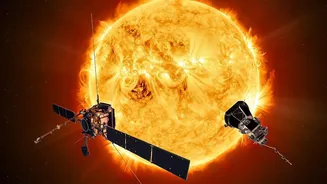
This is where predictive models become our first line of defence. Agencies like NOAA's Space Weather Prediction Center (SWPC) in the United States act like meteorologists for space. They use a constant stream of data from sun-observing satellites like the Solar and Heliospheric Observatory (SOHO) to monitor the sun for tell-tale signs of an Earth-directed eruption. Advanced models, such as the WSA-Enlil model, take this initial data and simulate the CME's path through space. These simulations forecast the storm's speed, density, and magnetic field orientation to predict its arrival time and potential severity. This provides a crucial window of warning, often a day or two in advance.
Putting Satellites on Standby
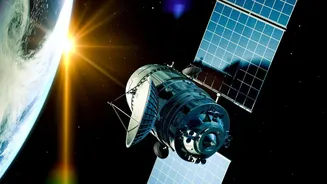
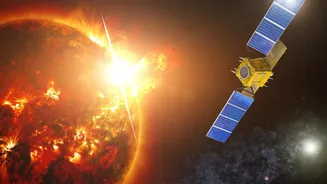
This advance warning is what allows satellite operators to protect their multi-million dollar assets. With a reliable forecast from a model, operators can take preventative measures. The most common action is to place a satellite into a 'safe mode'. This involves shutting down non-essential and sensitive electronic systems to minimise the risk of electrical damage from the incoming storm of charged particles. For satellites in low orbits, the warning can also provide time to plan for potential orbital adjustments to counteract the effects of increased atmospheric drag. It's a proactive strategy of 'battening down the hatches' that saves critical infrastructure from catastrophic failure. Without these models, operators would be flying blind, only learning of a storm when their systems start to fail.
The Future of Solar Forecasting
The field of space weather prediction is constantly evolving. Scientists and engineers are working to improve the accuracy and lead time of their forecasts. A key area of development is the use of artificial intelligence and machine learning, which can analyze vast amounts of solar data to identify complex patterns that precede flares and CMEs. New generations of space weather satellites are also being developed to provide higher-quality data. Systems like the European Space Agency's ASPECS tool use a multi-tiered approach, combining flare forecasts, particle onset data, and historical information to create more reliable predictions. The goal is to move from a reactive stance to a truly predictive one, giving operators and infrastructure managers on Earth even more time to prepare for the sun's inevitable fury.