


A Faint Discovery Years in the Making
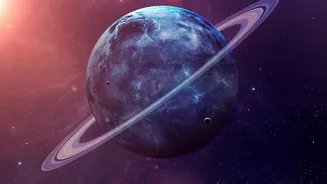
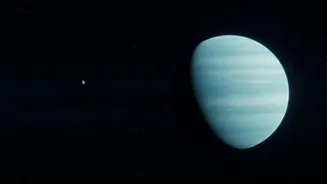
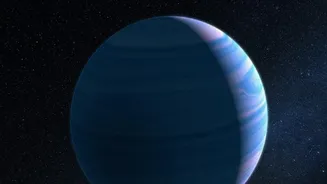
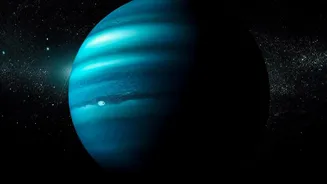
The discovery of S/2023 U1, the first new moon found around Uranus in over two decades, was announced in February 2024. Credit goes to astronomer Scott S. Sheppard of the Carnegie Institution for Science, who first spotted the object on November 4, 2023,
using the powerful Magellan telescopes in Chile. At just eight kilometres in diameter, it is likely the smallest of Uranus's 28 known moons and is exceptionally faint. Finding it required special image-processing techniques to make such a dim object visible against the glare of the distant planet. After the initial sighting, researchers were able to find the moon in older images taken as far back as 2021, which helped them confirm its orbit.
An Irregular and Telling Orbit
What makes S/2023 U1 particularly interesting to scientists is its orbit. It takes approximately 680 Earth days to circle Uranus on a path that is both distant and highly inclined. Unlike the larger, more familiar moons that orbit in the same plane as their planet's equator, this new moon is an "irregular satellite." Its orbit suggests it wasn't formed along with Uranus but was instead captured by the planet's gravity long ago. These captured objects often have wide, elliptical, and tilted orbits, making them valuable relics of the early solar system. By studying the specifics of this moon's long journey around the ice giant, scientists can gather clues about the conditions and gravitational forces at play during the solar system's formative years.
Clues to a Chaotic Past
The orbital behaviour of S/2023 U1 is more than just a curiosity; it's a window into the violent history of the Uranian system. Researchers have noted that its orbit is similar to two other irregular moons, Caliban and Stephano. This suggests that all three may be fragments of a single, larger parent moon that was shattered by a massive collision with a comet or asteroid millions or billions of years ago. By precisely modeling the orbits of these clustered moons, scientists can work backward to understand the nature of this ancient impact. The existence of such orbital groupings provides strong evidence that the outer solar systems were once much more chaotic places, with collisions reshaping planetary systems.
A Unified Theory of Giant Planets
The discovery also reinforces a growing understanding that all the giant planets in our solar system—Jupiter, Saturn, Uranus, and Neptune—share a similar history when it comes to their outer moons. Despite their differences in size, composition, and orientation, they all host families of irregular, captured satellites. Even Uranus, which is famously tipped on its side, has a moon population that mirrors its neighbours. According to Sheppard, this suggests a common mechanism for moon capture and system formation across all the gas and ice giants. Studying the orbit of S/2023 U1 helps fill in another piece of this universal puzzle, allowing for a more complete model of how these massive planetary systems evolved.