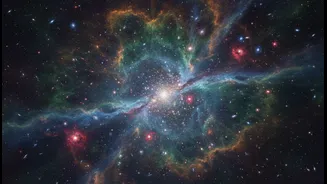





Seeing the Invisible
Think of infrared light as a kind of cosmic heat signature. Everything in the universe, from the coldest planets to the hottest stars, emits energy across a spectrum. Our eyes can only see a tiny sliver of this spectrum, the “visible light” of the rainbow.
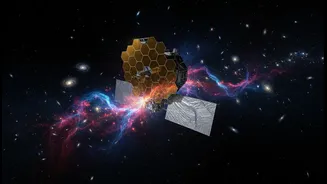
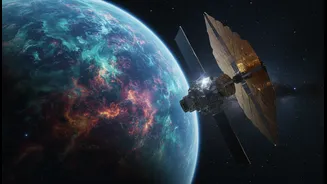
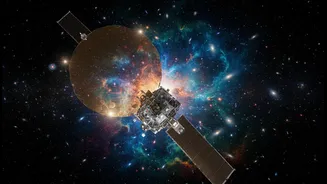
The James Webb Space Telescope is designed to see a different part of the spectrum: near- and mid-infrared light. This is light with wavelengths longer than the color red, making it invisible to the human eye. Much like night-vision goggles use thermal imaging to reveal warm objects in the dark, Webb’s instruments detect the faint infrared glow from distant celestial bodies. To do this, the telescope itself must be kept incredibly cold—below -223°C—so its own heat doesn't interfere with the faint signals from deep space. Its giant, gold-coated mirror is specifically designed to be highly reflective of infrared light, gathering the faintest glows from across the universe.
Peeking Through Cosmic Dust
One of infrared’s biggest advantages is its ability to pierce through cosmic dust. Throughout the universe, vast clouds of gas and dust act like thick fog, blocking visible light. This makes it impossible for telescopes like the Hubble Space Telescope, which primarily sees in visible light, to observe what’s happening inside these stellar nurseries. Infrared light, however, has longer wavelengths that can slip past these tiny dust particles more easily. This allows Webb to look inside these dense clouds and witness the birth of stars and planetary systems—processes that were previously shrouded in mystery. A stunning example is the comparison between Hubble's and Webb's views of the iconic Pillars of Creation. In Hubble's visible-light image, the pillars appear dark and opaque. But in Webb's infrared image, they become semi-transparent and ethereal, revealing countless newborn stars glowing red within and behind them.
A Telescope and a Time Machine
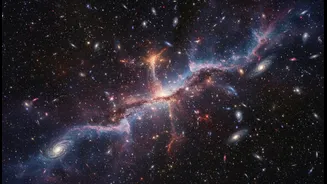
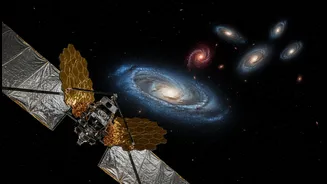
Webb’s infrared vision also turns it into a powerful time machine. The universe has been expanding since the Big Bang, and this expansion stretches light waves as they travel across cosmic distances. Light that was emitted as visible or ultraviolet light from the very first stars and galaxies has been stretched so much over 13 billion years that it arrives at our location as infrared light. This phenomenon is known as “redshift.” Because Hubble is not optimized for these long infrared wavelengths, it can't see these extremely distant, early objects. Webb, on the other hand, was specifically built to capture this ancient, redshifted light. This capability allows astronomers to study a crucial period known as the cosmic dawn, observing the formation of the first galaxies just a few hundred million years after the Big Bang. Webb has already discovered galaxies far more massive and mature in the early universe than previously thought possible, challenging existing theories of cosmic evolution.
New Frontiers of Discovery
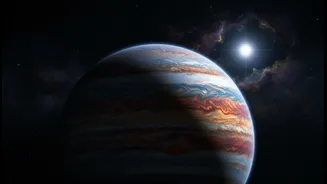
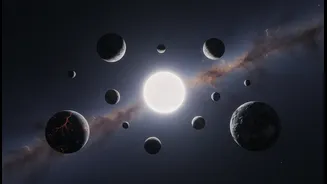
Beyond looking back to the dawn of time, Webb’s infrared sensitivity is opening up other new fields of discovery. It can analyze the chemical composition of atmospheres around exoplanets—planets orbiting other stars. As an exoplanet passes in front of its star, the starlight filters through the planet's atmosphere. Webb's instruments can detect which wavelengths of infrared light are absorbed by different molecules, revealing the presence of water, methane, and other potential signs of habitability. This was a capability Hubble did not possess. The telescope is also ideal for studying colder, dimmer objects like brown dwarfs and the dusty disks where planets form, which emit most of their energy in the infrared. By revealing the previously hidden or faint parts of our universe, Webb is providing crucial data that complements and extends the discoveries made by Hubble over the past three decades.