
Cosmic Snowballs on the Move
To understand their tails, we first need to know what comets are. Often called 'dirty snowballs', they are ancient cosmic leftovers from the formation of our solar system some 4.6 billion years ago. They are composed of a mix of frozen gases, water ice,
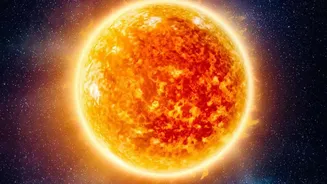
rock, and dust. For most of their long, elliptical orbits, comets remain frozen and inactive in the frigid outer reaches of the solar system, far beyond the planets. But as their orbit brings them closer to the Sun, things get interesting. The Sun's intense heat begins to vaporise the ice on the comet's surface in a process called sublimation, where the solid ice turns directly into gas. This process releases the gas and dust particles that were trapped within, forming a vast, glowing atmosphere around the comet's core, known as a 'coma'. This coma is the source material for the tails.
A Tale of Two Tails
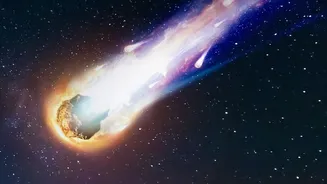
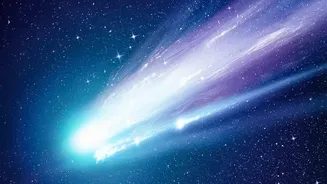
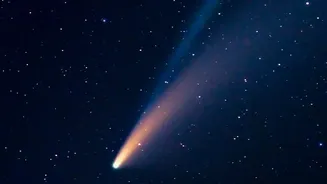
The secret to the tail's direction lies in the fact that most comets don't just have one tail—they have two. These two tails, a dust tail and an ion (or gas) tail, are made of different materials and are affected by the Sun in different ways. This is why they often point in slightly different directions, creating a spectacular celestial display. The dust tail is what we often think of as a classic comet tail. It's composed of tiny, solid particles—similar in size to particles in cigarette smoke—that have been released from the nucleus. The second tail, the ion tail, is made of gas that has been ionised, meaning the atoms have been stripped of electrons by the Sun's ultraviolet radiation, giving them an electrical charge.
The Gentle Push of Sunlight
The dust tail gets its direction from a surprisingly gentle force: the pressure of sunlight itself. Photons, the particles of light streaming from the Sun, have no mass, but they do have momentum. As countless photons strike the tiny dust particles in the coma, they transfer that momentum, giving the particles a slight push. This force is called solar radiation pressure. This pressure is strong enough to push the lightweight dust particles away from the Sun. However, these heavier dust particles still retain some of their original orbital momentum, lagging behind the comet in its path. The result is a broad, diffuse, and often gently curved tail that points generally away from the Sun, but also follows along the comet's orbital path. This tail is visible because the dust particles are very good at reflecting sunlight.
The Unrelenting Force of the Solar Wind
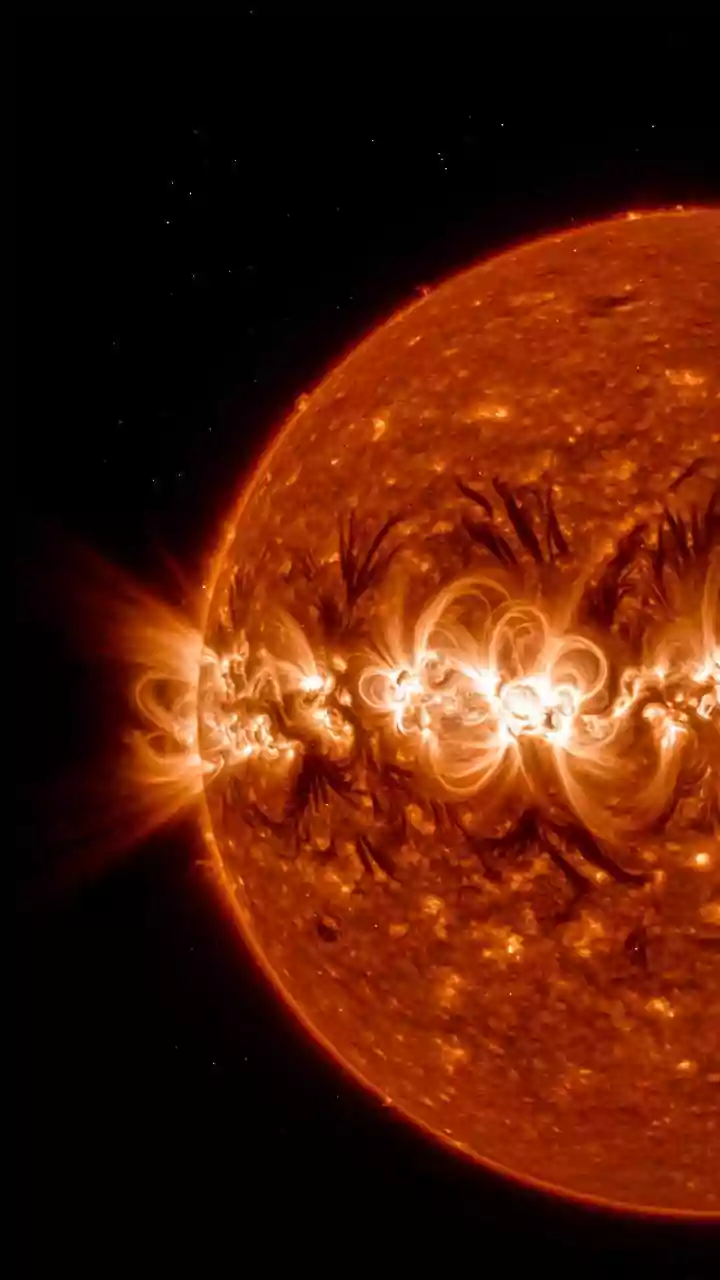
The ion tail behaves much more dramatically, and it's all thanks to the solar wind. The solar wind is a constant, high-speed stream of charged particles (mostly protons and electrons) continuously flowing outward from the Sun at speeds of around 400 kilometres per second. Because the gases in the ion tail are electrically charged, they are intensely affected by the solar wind and the magnetic field it carries. The solar wind effectively captures these ions and blasts them directly away from the Sun, like a flag flapping in a fierce gale. This force is so powerful that it completely overwhelms the comet's own motion, causing the ion tail to point almost perfectly straight and directly away from the Sun, regardless of which direction the comet itself is travelling. This tail glows, often with a blueish hue, not because it's reflecting light, but because the gases themselves are energised and emitting light.