




Manage Your Expectations, Not Your Hopes
Urban astronomy is a game of patience and knowing what to look for. The glow from city lights washes out fainter objects, so you won't see the Milky Way's misty band or distant galaxies. But don't be discouraged. The brightest celestial bodies are very
much within reach. The Moon is a spectacular target, with its craters and seas visible to the naked eye. Bright planets like Venus, Jupiter, Mars, and Saturn often outshine the brightest stars and are easily spotted. You can also trace prominent constellations and spot bright star clusters like the Pleiades. The key is to focus on these brilliant objects that light pollution can't erase.
Find Your Urban Observatory
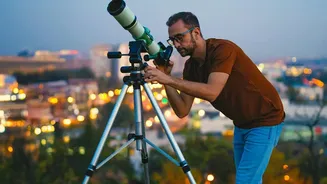
The first rule of stargazing is to get as far away from direct light as possible. While you can't escape the city's overall skyglow, you can significantly improve your view by minimizing immediate glare. Seek out a local park, a quiet rooftop, or even a balcony that is shielded from streetlights. The higher up you are, the less atmospheric haze and obstruction from buildings you'll have to deal with. Check your spot during the day to ensure it's safe and accessible at night. Even moving to the darkest corner of your backyard can make a noticeable difference. Turning off your own outdoor lights is a simple but effective first step.
Let Your Eyes Adapt to the Dark
Your eyes are the most important tool you have, but they need time to perform at their best. It takes about 20 to 30 minutes for your eyes to become fully dark-adapted, allowing you to see much fainter stars. During this time, you must avoid all sources of bright, white light. That means putting your phone away. Even a quick glance at a bright screen can reset your night vision, forcing you to start the waiting process all over again. If you need to use a light, use a red flashlight, as red light has the least impact on your night vision. Many stargazing apps have a 'red light mode' for this exact reason.
Use Your Smartphone as a Guide
While the screen's white light is your enemy, your phone can also be your greatest ally. Modern stargazing apps use your phone's location and sensors to create a real-time map of the sky. Just point your device upwards, and the app will identify the stars, constellations, and planets you're looking at. Many apps are designed for beginners, with user-friendly interfaces and augmented reality (AR) overlays that make identification simple. Popular and highly-rated free options include Star Walk 2, SkyView Lite, and Stellarium Mobile. These apps can also tell you the rise and set times for planets and notify you of celestial events like meteor showers or satellite flyovers, so you know exactly when to look up.
Know the Easiest Targets
Once you're set up, start by spotting the most obvious objects. The Moon is your first and best target. After that, look for the planets. A simple rule of thumb is that stars twinkle, but planets shine with a steadier light. Venus is often the brightest object in the evening or morning sky, while Jupiter is a brilliant, unwavering point of light. Mars is noticeable for its distinct reddish hue, and Saturn appears as a steady, yellowish-white star. For constellations, start with easy-to-find patterns. In the Northern Hemisphere, the Big Dipper (part of Ursa Major) and Orion are excellent starting points for any beginner.
Take the Next Step with Binoculars
You don't need a telescope, but a standard pair of binoculars—even an older pair you might already have—can revolutionize your urban stargazing. Binoculars gather more light than your eyes, revealing countless more stars and adding incredible detail to the objects you can already see. With a 7x or 10x pair, the Moon transforms from a flat disc into a three-dimensional world of mountains and craters. You might even be able to spot Jupiter's four largest moons, appearing as tiny pinpricks of light lined up next to the planet. Binoculars are the perfect, accessible next step for any city-bound astronomer.