


A Sugar Found in Raspberries, 27,000 Light-Years Away
Astronomers have detected a molecule called erythrulose, a type of sugar, floating in a vast cloud of gas and dust near the center of our Milky Way galaxy. This marks the first time a true sugar has been found in interstellar space. The discovery was
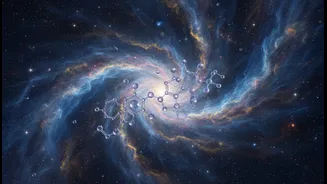
made by an international team using powerful radio telescopes in Spain, which identified the unique radio frequency 'fingerprint' of the molecule in a region known as G+0.693-0.027. This molecular cloud is a known cosmic factory, rich in the complex organic molecules that are considered precursors to life. On Earth, erythrulose is a simple four-carbon sugar found in things like raspberries. Finding it in the void between stars suggests that the chemistry needed to create essential biological molecules is not unique to planets.
Why This Cosmic Sugar Is a Big Deal
Sugars are fundamental to life as we know it. They provide energy, form structural components in cells, and, most importantly, are a key part of the backbone of RNA and DNA, the genetic blueprints for all living things. For a long time, scientists have debated how the first sugars formed on a young Earth, as laboratory experiments simulating those conditions have struggled to produce them in sufficient amounts. Sugars like glucose and ribose had previously been found in meteorites and asteroid samples, hinting that they might have been delivered to Earth from space. The detection of erythrulose floating freely in an interstellar cloud takes this idea a crucial step further. It proves that such complex molecules can form naturally in the harsh, cold environment of space, well before they are incorporated into asteroids or planets.
The Chemical Scaffolding for New Worlds
The headline's term 'chemical scaffolding' refers to the idea that these prebiotic molecules serve as the foundational framework for life's chemistry. Star-forming regions like Sagittarius B2, near where erythrulose was found, are the birthplaces of new stars and planetary systems. The discovery suggests that complex organic molecules are formed on the surfaces of icy dust grains in these cold clouds. As a new star begins to form, it is surrounded by a rotating disk of this very gas and dust. This material, already seeded with sugars and other vital ingredients, then clumps together to form planets, comets, and asteroids. In essence, the building blocks of life are part of the initial planetary construction kit. Instead of a planet having to create these ingredients from scratch, they are delivered ready-made from the interstellar cloud that gave it birth.
From Cosmic Dust to Life's Origins
This discovery helps bridge a major gap in our understanding of the origin of life. It provides a plausible pathway for how early Earth could have acquired a significant inventory of sugars. Researchers estimate that during the Late Heavy Bombardment period about 4 billion years ago, millions of tons of erythrulose could have been delivered to Earth's surface by comets and meteorites. This cosmic delivery would have provided the raw materials needed for the first metabolic and genetic processes to emerge. The detection was also surprising because astronomers found an abundance of this four-carbon sugar, but very little evidence of simpler three-carbon sugars. This challenges the long-held assumption that complex molecules in space build up one carbon atom at a time, hinting at more complex chemical pathways at play.