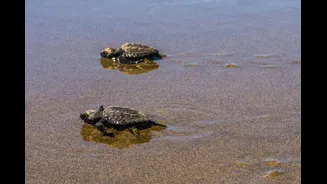








An Ancient Ritual Under Threat
Every year, between November and March, female Olive Ridley sea turtles swim thousands of kilometres to return to the very beaches where they were born. Under the cover of darkness, they haul themselves onto the sand to lay their eggs, a ritual that has
unfolded for centuries. However, this ancient cycle is facing modern threats. Classified as 'Vulnerable' by the IUCN, these turtles and their hatchlings are increasingly endangered by unregulated coastal development, artificial lighting from beach shacks and resorts that disorients them, and other human activities. A recent decline in nesting numbers has added urgency to the situation, prompting the government to consider more formal protections.
The Forest Department's Protection Plan
In response to these challenges, Goa's Forest Department has sent a significant proposal to the Department of Environment and Climate Change. The plan is to officially declare 24 beaches across the state—14 in the South and 10 in the North—as designated turtle nesting sites under the Coastal Regulation Zone (CRZ) Notification, 2019. This designation would classify these areas as ecologically sensitive, allowing for much stricter regulations during the nesting season. Proposed controls could include limits on artificial lighting, noise from events, vehicle movement on the beach, and the operation of temporary structures like shacks, particularly at night.
The 14 Beaches in South Goa
The proposal specifically focuses on a significant stretch of the southern coastline, including some of Goa's most beloved and commercially active beaches. The fourteen beaches identified in South Goa are: Rajbag, Mobor, Carmona, Cavelossim, Varca, Cabo de Rama, Cola, Baina, Patnem, Palolem, Talpona, Agonda, and Galgibag. Notably, Agonda and Galgibag are already recognised and protected as key nesting sites, with the latter often referred to as 'Turtle Beach' by locals. The proposal seeks to formalise and extend similar protections across this much wider area, acknowledging that turtles often nest on beaches beyond the currently protected zones.
A Clash of Conservation and Commerce
The proposal has sparked an intense debate, pitting ecological preservation against economic livelihood. Tourism stakeholders, especially shack owners and traditional fishermen, have expressed significant concern. They worry that broad restrictions across so many popular beaches during peak tourist season could devastate their businesses and the local economy, which is heavily dependent on beach tourism. Representatives from the Shack Owners Welfare Society have argued for a more practical approach, suggesting protections be limited to specific stretches rather than entire beaches, and have asked for clarity on what activities would be permitted. They contend that local communities are not against protecting turtles but fear the move could drive them out of business.
Finding a Sustainable Path Forward
Conservationists and Forest Department officials argue that these measures are essential for the long-term survival of the Olive Ridley turtle in Goa. They point out that a healthy coastal ecosystem, including its unique wildlife, is a key reason tourists visit Goa in the first place. Some conservation approaches already involve community participation, where locals are involved in monitoring nests and ensuring hatchlings make it to the sea. Proponents believe that well-managed eco-tourism could offer a sustainable alternative, preserving both the turtles and the tourism industry. The challenge lies in creating a framework that enforces CRZ rules without alienating the very communities whose cooperation is crucial for successful conservation.