



The Allure of a Toxic Twin
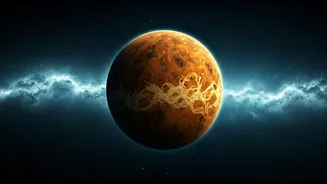
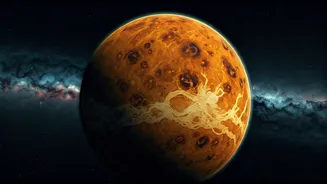
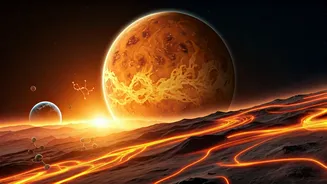
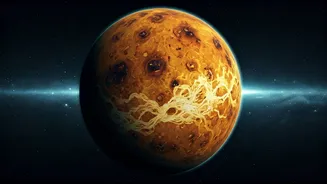
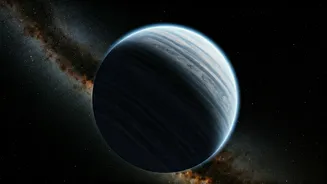
Venus is a planet of extremes. With a surface temperature hot enough to melt lead—around 465 degrees Celsius—and a crushing atmospheric pressure 90 times that of Earth's, it’s one of the most inhospitable places in the solar system. Its skies are filled
with clouds of corrosive sulphuric acid. Yet, for all its hostility, Venus is remarkably similar to Earth in size, mass, and composition, earning it the nickname "Earth's twin". Scientists believe that billions of years ago, Venus may have even hosted liquid water oceans, much like our own world. Something went catastrophically wrong, leading to a runaway greenhouse effect that boiled its oceans away and turned it into the scorching world we see today. Understanding this process is a key reason for the renewed global interest; Venus serves as a natural laboratory for studying climate change, offering a cautionary tale of how a planet's climate can dramatically shift.
Introducing Shukrayaan: India's Next Big Leap
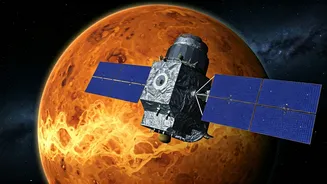
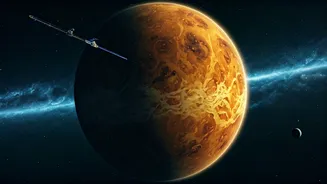
Enter Shukrayaan-1, the formal name for the Indian Space Research Organisation's (ISRO) planned Venus Orbiter Mission. Following the cabinet's approval, this mission marks India’s first foray to the second planet from the Sun and its next major interplanetary step after the successes of Chandrayaan (Moon) and Mangalyaan (Mars). The mission, now targeting a launch in March 2028, will involve a 2500 kg spacecraft placed in a large elliptical orbit around Venus. From this vantage point, it will spend approximately four years studying the planet. Its primary objectives are to map the surface and subsurface, analyse the complex and toxic atmosphere, and investigate the interaction between Venus and the solar wind.
Peering Beneath the Clouds
One of Shukrayaan's key instruments will be a high-resolution Synthetic Aperture Radar (SAR). This is crucial because Venus's dense cloud cover makes it impossible to see the surface with conventional cameras. Radar can penetrate these clouds, allowing scientists to create detailed maps of the planet's geology, including its volcanoes and lava flows. The mission also aims to be the first to perform a subsurface investigation, using a ground-penetrating radar to study the rock layers beneath the surface—a field known as stratigraphy. This could reveal secrets about Venus's geological history that have remained hidden from all previous missions.
A Race for Knowledge and Prestige
The headline's mention of a "race" isn't just for dramatic effect. While ISRO has been developing its Venus mission concept for years, there's a renewed global rush to explore our neighbouring world. NASA is planning two missions, VERITAS and DAVINCI, while the European Space Agency is developing its EnVision orbiter. China also has expressed ambitions for a Venus mission. For India, a successful Shukrayaan mission would not only yield invaluable scientific data but also solidify its position as a major player in planetary exploration. It’s a strategic move to demonstrate advanced technological capabilities and participate in a new frontier of collaborative and competitive space science.
Unlocking Clues to Our Own Future
Ultimately, the quest to understand Venus is also a quest to better understand Earth. By studying how and why Earth’s twin took such a different evolutionary path, scientists can refine their models of planetary habitability and climate change. The data from Shukrayaan could provide critical insights into how a runaway greenhouse effect unfolds, offering lessons that are directly relevant to managing our own planet's delicate atmosphere. The mission, therefore, is not just about looking outward to a distant planet; it’s about gaining a new perspective on our own home and the factors that allow life to flourish.