




The water in your glass may have a more complex and mysterious origin story than you think. A recent NASA-supported study of cosmic dust from the solar system's frozen frontier, the Kuiper Belt, is rewriting what we know about where Earth's water came
from.
A Cosmic Fingerprint Called Isotopes
To understand this discovery, we first need to talk about isotopes. Think of them as a chemical fingerprint. Most elements come in slightly different versions, or isotopes, which have the same number of protons but a different number of neutrons. Water is made of hydrogen and oxygen, and oxygen has three stable isotopes: oxygen-16 (the most common), oxygen-17, and oxygen-18. The ratio of these isotopes in a substance can tell scientists a lot about where that substance formed. For decades, researchers have used these isotopic signatures to trace the origins of planets, asteroids, and comets, piecing together the history of our solar system. The water in Earth's oceans has a very specific and consistent oxygen isotope ratio, a baseline against which all extraterrestrial water is compared.
A Reservoir of Frozen History
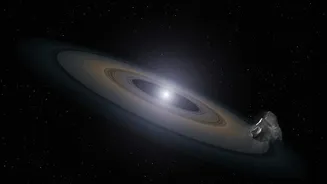
The Kuiper Belt is a vast, doughnut-shaped ring of icy bodies circling the Sun beyond the orbit of Neptune. Because it's so far from the Sun's heat, it's considered a deep freeze of primordial material, containing leftovers from the solar system's formation 4.6 billion years ago. This makes it a treasure trove for scientists. Comets, often described as dirty snowballs, are some of the most famous residents of the Kuiper Belt. For a long time, a leading theory was that comets from this region, crashing into a young, hot Earth, delivered the bulk of our planet's water after it cooled down. If this were true, the isotopic fingerprint of water in the Kuiper Belt should closely match that of Earth's oceans.
Catching Dust from the Edge of the Solar System
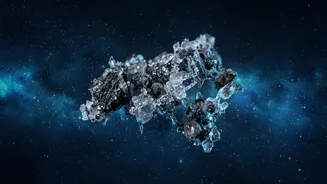
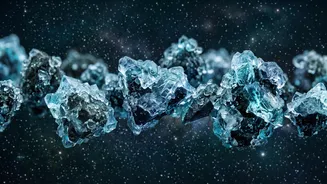
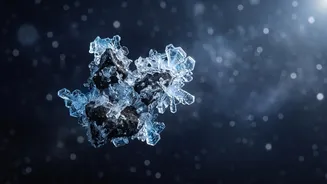
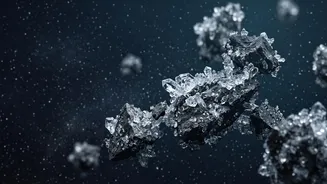
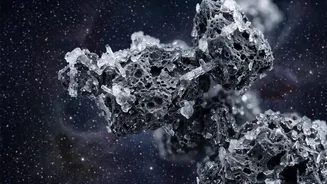
So, how do you study the Kuiper Belt without sending a spacecraft on a multi-decade journey? You wait for pieces of it to come to you. NASA aircraft fly high into the stratosphere to collect tiny interplanetary dust particles (IDPs) that rain down on Earth. A recent study, led by scientist Lindsay Keller, focused on a specific set of these particles. The team was able to confirm their origin from the Kuiper Belt by analyzing the microscopic scars and tracks left on them by solar energetic particles—damage that indicates a long, slow journey from the outer solar system. These tiny grains are messengers, carrying direct evidence from one of the most remote regions of our cosmic neighborhood.
A Surprising Isotopic Mismatch
Upon analyzing the minerals within these dust particles, researchers found something fascinating. The grains were rich in carbon and contained hydrated minerals, which only form in the presence of water. This confirmed that their parent bodies in the Kuiper Belt once held liquid water. However, when the team measured the oxygen isotopes, they found a significant difference from Earth's water. The water locked within these minerals was enriched in 'heavy' oxygen isotopes (oxygen-17 and oxygen-18). This finding provides compelling evidence that the Kuiper Belt contains a massive, primordial reservoir of water that is isotopically different from our own. It suggests this outer region remained largely isolated, preventing its materials from mixing with those in the inner solar system where Earth formed.
Rewriting the Story of Our Water
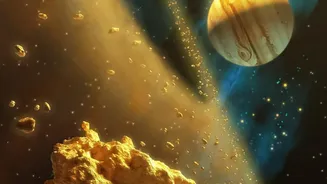
This discovery throws a wrench into the simple idea that comets from the Kuiper Belt alone filled Earth's oceans. While they may have contributed some water, they likely weren't the main source. So, if not primarily from these far-flung comets, where did our water come from? The scientific consensus is shifting toward another culprit: asteroids. Specifically, carbonaceous chondrites, a type of ancient meteorite from the outer asteroid belt (between Mars and Jupiter), have an isotopic composition that is a much closer match to Earth's water. The current thinking is that these water-rich asteroids were the primary delivery service for Earth's H2O. This new study doesn't close the book on the story of our water, but it adds a crucial and unexpected chapter, highlighting that different zones of the solar system had their own distinct water supplies.