






Chasing Away the Plague
Behdienkhlam, the most significant festival of the Pnar people, is a powerful expression of faith and culture. The name itself, from the Pnar language, translates to “chasing away the plague”. It is a deeply rooted tradition for those who follow the indigenous
Niamtre faith. Celebrated annually after the sowing season, its primary purpose is twofold: to drive away sickness and evil spirits and to invoke divine blessings for a bountiful harvest. Historically, the festival is believed to have originated to ward off a devastating plague, and that spirit of communal protection and cleansing remains at its core. It is more than just a ceremony; it is an affirmation of the deep connection between the community, their agricultural livelihood, and the spiritual world.
Rituals of Cleansing and Protection
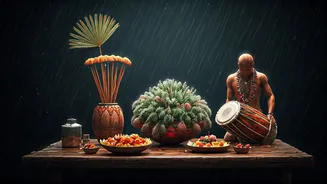
The festival unfolds over four days through a series of captivating rituals. One of the most symbolic acts involves young men moving from house to house, beating the rooftops with bamboo poles. This is not random noise; it is a symbolic gesture, a percussive prayer meant to drive away illness and misfortune from every home. The festival's rituals are led by the 'Daloi', the chief religious figure, who performs rites and makes offerings. Another key event is the 'Knieh Khnong', where men scramble over a large, sacred wooden beam. Securing a foothold on this log is believed to cleanse one's soul and bring good health, a physical manifestation of spiritual renewal.
A Procession of Towering Rots
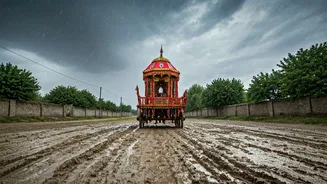
The visual climax of Behdienkhlam is the procession of the 'rots'. These are towering, intricately decorated wooden structures, sometimes reflecting current social themes, built by different localities of Jowai. Carried on the shoulders of dozens of men, these colourful towers are paraded through the streets amidst dancing and the music of pipes and drums. The procession culminates at a sacred pool known as Aitnar. Here, in a final, dramatic act, the rots are ceremonially immersed in the muddy water, symbolizing the casting out and drowning of all evil, negativity, and disease from the community. The desired presence of rain during the festival is seen as a blessing, enhancing the symbolism of cleansing and agricultural prosperity.
A Divine Game for a Good Harvest
The festival’s connection to agriculture is vividly displayed in a game called 'Dad-lawakor'. Played on the final day, it resembles a spirited game of football but is played with a small wooden ball. The match is contested between two teams representing the northern and southern regions of Jowai. The outcome is believed to be a divine forecast; the region of the winning team is predicted to have a more bountiful harvest in the year to come. This ritual transforms a simple game into a powerful community prayer, where collective hope and friendly rivalry merge to seek favour from nature.
Community and Continuity
While the men lead the vibrant public processions and rituals, women play a crucial, though less visible, role. They are entrusted with preparing sacrificial food and performing rites to honour the ancestors, a practice known as 'ka Siang ka pha'. This veneration of forefathers is a foundational part of the festival, highlighting the Pnar belief in the continuity of clan and tradition. Behdienkhlam is ultimately a homecoming, a time when family members and community come together, strengthening social bonds and reaffirming their shared identity. It serves as a powerful reminder of how faith, nature, and human community are inextricably linked.