






An Icon's Inevitable Decline
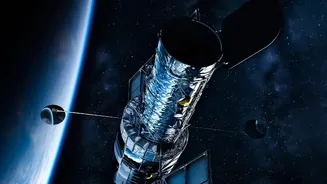
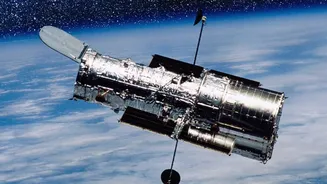
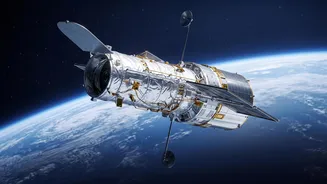
The Hubble Space Telescope is more than just a scientific instrument; it's a cultural icon responsible for some of the most breathtaking images of our universe and discoveries that have reshaped astronomy. Launched in 1990, it has long outlived its initial
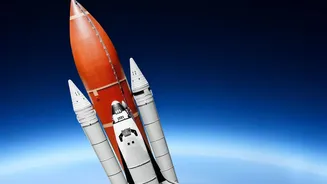
15-year mission thanks to five daring servicing missions by Space Shuttle astronauts. But with the shuttle fleet retired, Hubble has been on its own since 2009. The telescope has no onboard propulsion system to maintain its orbit. Like any object in low-Earth orbit, it is subject to faint atmospheric drag, which is slowly but surely pulling it back towards Earth. Its altitude has been steadily decreasing, a process known as orbital decay. If nothing is done, NASA projects it will make an uncontrolled reentry into the atmosphere sometime in the mid-2030s.
A Formal Call for Ideas
Recognizing the urgency, NASA issued an official Request for Information (RFI) in late October 2026, a formal invitation for the private space sector to propose solutions. This isn't a contract for a mission but a crucial first step for NASA to gauge the capabilities, costs, and concepts the commercial market can offer. The RFI outlines three potential paths: a 'reboost' to push Hubble into a higher, more stable orbit; a servicing mission to repair or upgrade its systems; or a plan for a safe, controlled deorbit to ensure it doesn't become a hazard. A reboost to an altitude of 600 kilometers could extend Hubble's life by another 15 to 25 years, allowing it to continue its valuable scientific work. Responses from companies are due by November 30, 2026.
The New Era of Space Stewardship
NASA's move signals a major evolution from its past approach. The Space Shuttle missions that built and maintained Hubble were massive, government-run endeavours. Now, the agency is looking to the burgeoning private space industry, which has seen rapid growth in recent years. Companies like SpaceX, Blue Origin, and a host of smaller startups focused on satellite servicing are developing the technologies that could make a Hubble rescue mission feasible. A commercial partner would be expected to provide everything from the launch vehicle and spacecraft to the mission operations, and potentially even the crew if a human-led mission is proposed. This public-private partnership model allows NASA to leverage commercial innovation and potentially find a more cost-effective solution than a traditional government-led program.
Potential Players and Precedents
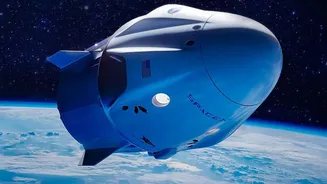
This isn't the first time a private Hubble mission has been discussed. In 2022, NASA and SpaceX signed an agreement to study the feasibility of using a Dragon spacecraft to reboost the telescope as part of the privately funded Polaris Program, led by billionaire Jared Isaacman. That study concluded a mission was technically possible, though NASA decided not to pursue the option at that time. Now, with Isaacman as NASA's new administrator, the door has been reopened to the entire industry. While a crewed mission remains a possibility, many experts believe a robotic mission is more likely. Companies like Astroscale and Northrop Grumman are developing robotic 'space tugs' designed for exactly this kind of on-orbit servicing, representing a different technological path than a crewed Dragon capsule.
What's at Stake for Science
Saving Hubble is about more than preserving a historical artifact. While the James Webb Space Telescope observes the universe in infrared light, Hubble remains the premier observatory for visible and ultraviolet light. Its capabilities are unique and complementary to Webb's, and astronomers believe it still has years of important science ahead. Without a reboost, the scientific community would lose this critical eye on the sky, with its likely successor, the Habitable Worlds Observatory, not expected to launch until the 2040s. The decision NASA makes based on the responses to its RFI will not only determine the fate of the Hubble Space Telescope but also set a precedent for how we maintain and extend the life of crucial assets in orbit for decades to come.