



A Familiar but Peculiar Neighbour
Located a mere 11 to 13 million light-years away, Centaurus A is one of the closest active galaxies to our own Milky Way. This proximity makes it a crucial laboratory for understanding processes that shape galaxies across the cosmos. What makes Centaurus A so
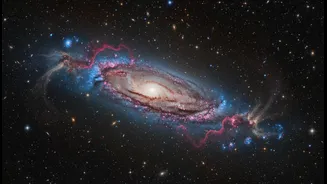
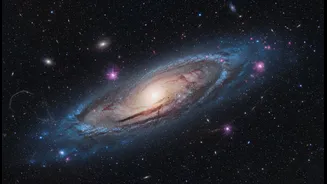
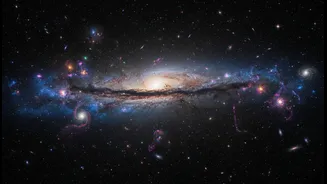
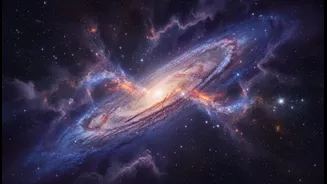
peculiar is its structure: it appears as a giant elliptical galaxy sliced in two by a thick, dark lane of dust. Astronomers believe this is the remnant of a violent collision around two billion years ago, when a large elliptical galaxy merged with a smaller spiral galaxy. This cosmic crash supplied the galaxy with vast amounts of gas and dust, providing the raw material for intense star formation and fuel for the supermassive black hole lurking at its core.
The View Before Webb
Previous observatories have studied Centaurus A extensively, each adding a piece to the puzzle. The Hubble Space Telescope, observing in visible light, captured the galaxy's bright stars but was thwarted by the dense dust lane that obscured its core. Later, infrared telescopes like the retired Spitzer Space Telescope could peer into these dusty regions, but they lacked the resolution to see fine details. They revealed large-scale structures of gas and dust but couldn't distinguish the millions of individual stars packed within, leaving the galaxy's central engine and true history partially hidden.
Webb's Infrared Breakthrough
This is where the James Webb Space Telescope changes the game. As a technology, Webb is designed to see the universe in infrared light, which can pass through the cosmic dust that blocks visible light. Its combination of the Near-Infrared Camera (NIRCam) and Mid-Infrared Instrument (MIRI) provides both unprecedented sensitivity and sharpness. For the first time, what once appeared as a hazy glow is resolved into a dense field of millions of individual stars. This ability to conduct 'galactic archaeology' allows scientists to study different generations of stars, helping them piece together a detailed timeline of the galaxy's tumultuous past—which stars existed before the merger, which formed during it, and which were born in its aftermath.
New Clues and Deeper Mysteries
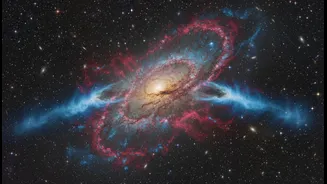
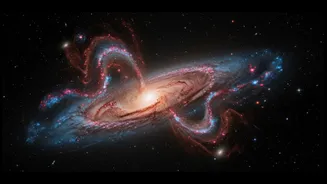
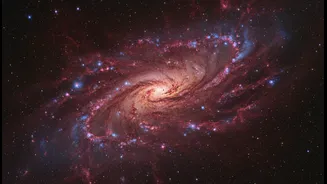
The new images are more than just a sharper view; they are a treasure trove of new information. Webb's mid-infrared vision highlights intricate, glowing dust structures, including a strange, warped, parallelogram-shaped band across the center. It also revealed a mysterious S-shaped feature that has scientists asking new questions about the forces at play. Furthermore, the telescope can detect the motion of gas, revealing warmer molecular hydrogen rotating near the black hole while other gas is being pushed outward by powerful jets. This provides direct evidence of the complex relationship between a supermassive black hole and its host galaxy—how it can both trigger star formation by compressing gas and simultaneously stifle it by blasting material away.
The Real Impact: A Laboratory for Galaxy Evolution
So, what is the real impact beyond the headline? This new view of Centaurus A isn't just one more beautiful space picture. It transforms the galaxy into a high-definition laboratory for understanding the most fundamental processes in the universe. Because Centaurus A is so close, Webb can study the physics of a galactic merger, the lifecycle of stars, and the influence of a supermassive black hole in a level of detail impossible in more distant galaxies. Each newly resolved star and filament of dust helps refine our models of how all galaxies, including our own, grow and evolve over billions of years. The image is a perfect demonstration of Webb's value—not just as a camera, but as a time-traveling tool for decoding cosmic history.