








A New Space Race Begins
India's space story, long synonymous with the Indian Space Research Organisation (ISRO), is undergoing a seismic shift. The government's decision in 2020 to open the sector to private enterprise has ignited a domestic space race. This reform was formalised
with the Indian Space Policy 2023, a framework designed to empower non-governmental entities (NGEs) to undertake end-to-end space activities. The policy created the Indian National Space Promotion and Authorisation Centre (IN-SPACe) to act as a single-window agency, streamlining approvals and providing private firms access to ISRO's vast infrastructure and expertise. This move allows ISRO to pivot its focus towards research and deep space exploration, while private companies commercialise mature technologies like launch services, fundamentally changing the country's space economy.
The Trailblazers: Skyroot and Agnikul
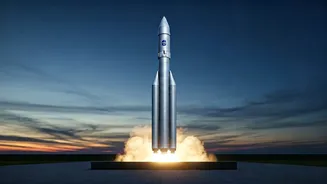
Two startups have emerged as frontrunners in this new era: Skyroot Aerospace and Agnikul Cosmos. Hyderabad-based Skyroot Aerospace first made history in November 2022 with the launch of Vikram-S, India's first privately built suborbital rocket. The company is now on the cusp of an even greater milestone. Its first orbital-class rocket, Vikram-1, is scheduled for its maiden launch, Mission Aagaman, between July 12 and August 4, 2026. This seven-storey vehicle is designed to carry small satellites up to 350 kg into low Earth orbit and marks a critical step toward commercial operations. Meanwhile, Chennai-based Agnikul Cosmos, an IIT-Madras incubated startup, achieved a significant feat in May 2024. It successfully launched its suborbital demonstrator, Agnibaan SOrTeD, powered by the world's first single-piece 3D-printed, semi-cryogenic engine. The launch was also the first from a private launchpad in India. These successful test flights by both companies are not just technical demonstrations; they are powerful statements of intent.
Small Satellites, Big Opportunities
The primary target for these emerging rocket builders is the booming global market for small satellite launches. Historically, small satellite operators had to piggyback on larger, more expensive missions, often facing long delays. Private Indian companies aim to offer a more flexible, faster, and cost-effective alternative. Skyroot's Vikram-1 is engineered for rapid manufacturing and a high launch frequency, while Agnikul's Agnibaan vehicle is being designed to be customisable for different orbital needs. By focusing on this niche, these firms are not directly competing with ISRO's heavy-lift rockets but are instead complementing the national space infrastructure. This strategic focus aims to capture a larger share of the global space economy, which is projected to grow significantly in the coming decade.
The Path to Orbit and Beyond
While the progress is impressive, the road ahead is filled with challenges. Rocket science is notoriously difficult, and transitioning from successful suborbital tests to reliable orbital launches is a massive technological leap. These companies must prove not only their engineering prowess but also their commercial viability by securing a steady stream of customers. Government support through IN-SPACe and continued access to ISRO facilities will remain crucial. The upcoming Vikram-1 launch is a pivotal moment; a successful mission would validate the private model and unlock further investment, potentially positioning India as a major hub for commercial space launches. The success of these pioneers will determine the trajectory of India's private space industry for years to come, proving that the sky is no longer the limit.