


The Constant Drag of Low-Earth Orbit
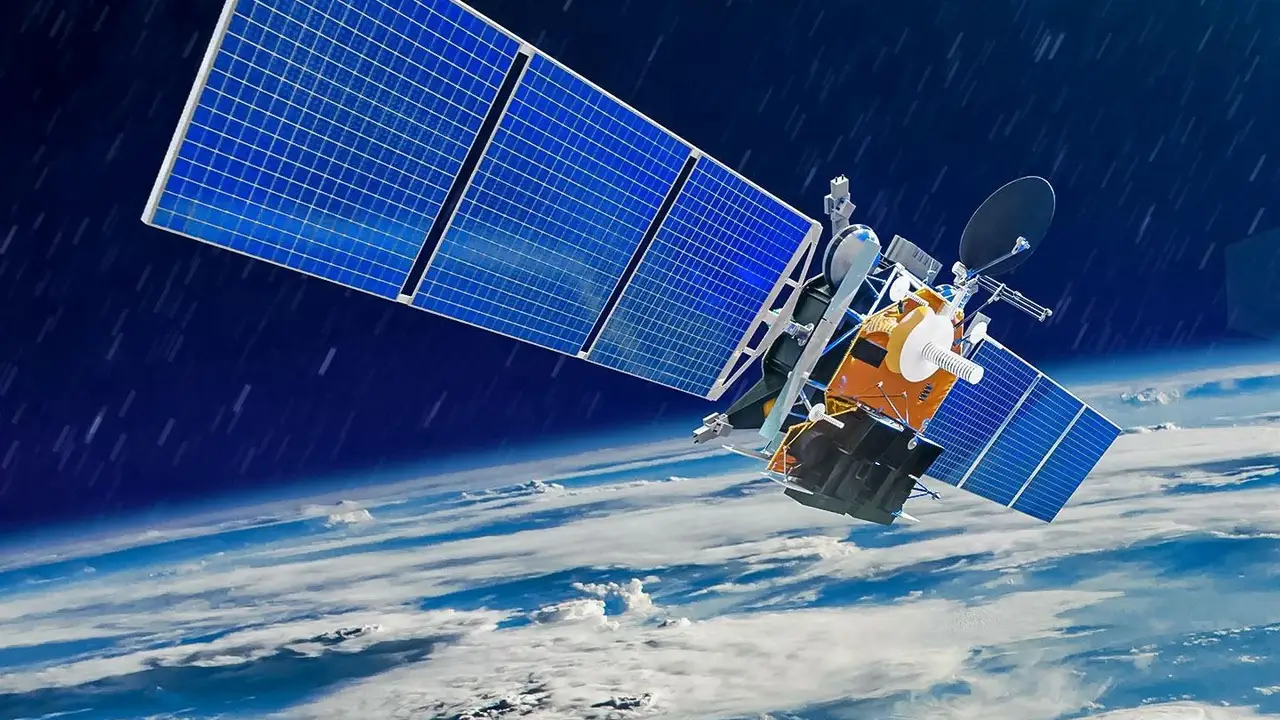
Low-Earth orbit (LEO), an altitude below 2,000 kilometres, is prime real estate for satellites providing services from high-speed internet to detailed Earth observation. Being closer to the ground means better image resolution, lower communication latency,
and stronger signals. However, this region isn't a perfect vacuum. It contains a thin but persistent atmosphere composed of particles like atomic oxygen and nitrogen. As a satellite speeds along at roughly 7.8 kilometres per second, it constantly collides with these particles. This creates atmospheric drag, a frictional force that slows the satellite down, causing its orbit to decay. To combat this, satellites must fire thrusters to boost themselves back up, a process that consumes precious onboard propellant and ultimately limits the mission's lifespan.
A Revolutionary Concept: Inhaling the Atmosphere
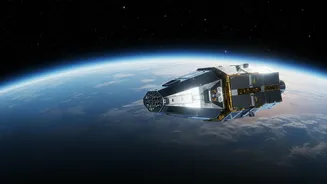
What if, instead of fighting the atmosphere, satellites could use it as an infinite fuel source? This is the core idea behind Air-Breathing Electric Propulsion (ABEP). This innovative technology is designed to collect the residual atmospheric molecules that cause drag and use them as propellant for an electric thruster. By ingesting the very particles that slow it down, an ABEP-equipped satellite could theoretically compensate for drag indefinitely, allowing it to maintain its orbit for years without carrying large, heavy tanks of conventional fuel like xenon. This transforms atmospheric drag from a mission-ending liability into a renewable resource, paving the way for a new class of long-duration missions in very low orbits (VLEO), typically between 150 and 400 kilometres.
How It 'Breathes' in Space
The ABEP system works through a two-step process. First, a specially designed, passive intake at the front of the satellite scoops up the incoming atmospheric particles. The design is critical; it must efficiently collect and compress these scarce molecules without them simply bouncing off. Once collected, the atmospheric gases—mostly nitrogen and oxygen—are channelled into an electric thruster. Inside the thruster, the particles are ionized, meaning they are given an electric charge. An electric field then accelerates these newly created ions and expels them at high velocity, generating a continuous, low-level thrust that counteracts the atmospheric drag. The entire system is powered by the satellite's solar arrays.
Game-Changing Advantages for Space
The implications of mastering ABEP technology are enormous. By eliminating the need for onboard propellant, satellites can be smaller, lighter, and cheaper to launch. Mission lifespans would no longer be dictated by fuel reserves but by the durability of the satellite's components. This opens the door to “indefinite” missions in VLEO. Operating at these lower altitudes offers significant performance boosts for telecommunications, surveillance, and environmental monitoring. Furthermore, ABEP promotes a more sustainable use of space. Satellites in VLEO naturally deorbit and burn up within weeks or months of their mission's end, thanks to the very same atmospheric drag. This self-cleaning characteristic helps mitigate the growing problem of space debris, ensuring these orbital highways remain clear for future generations.
From Theory to Tangible Tech
Air-breathing electric propulsion is no longer just a theory. The European Space Agency (ESA) has been a key player in its development, successfully building and test-firing a prototype in a vacuum chamber that simulated the conditions at a 200-kilometer altitude. The tests proved that the concept of collecting and ionizing atmospheric molecules for thrust is tangible and workable. Several research initiatives and companies across Europe are now advancing the technology, focusing on challenges like improving intake efficiency and developing thruster materials that can withstand the corrosive effects of atomic oxygen. While a fully integrated ABEP system has yet to be tested in orbit, the progress from concept to successful ground demonstration marks a critical step toward realizing this next-generation propulsion system.