

Listening to Cosmic Echoes
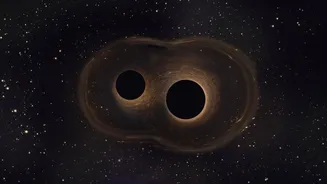
For most of human history, our understanding of the cosmos came from what we could see. Today, we listen. Gravitational waves, ripples in the very fabric of spacetime, are caused by cataclysmic events like the merger of two black holes. First detected
in 2015, these waves are like echoes from billions of years ago. International collaborations like LIGO, Virgo, and KAGRA operate massive, incredibly sensitive detectors that can pick up these faint signals. Each 'chirp' they record contains a wealth of information about the objects that created it: their mass, their spin, and how they collided. With the recent release of a new catalogue of detections, the number of observed events has surged, giving scientists an unprecedented amount of data to analyse.
A New Class of Cosmic Titans
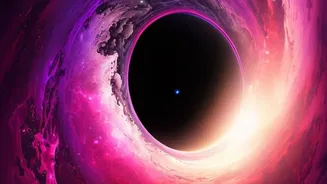
The standard model of black hole formation was straightforward: a massive star dies, its core collapses, and a black hole is born. But the flood of new data is revealing that the story is much more complex. Recent analyses show that merging black holes aren't a single, uniform population. Instead, they seem to fall into distinct groups, suggesting they are formed through different 'cosmic assembly lines'. The most exciting discovery is the growing evidence for 'hierarchical merging'. This is the idea that some of the black holes we detect are not first-generation objects born from stars. Instead, they are the result of previous black hole mergers. Think of it as cosmic recycling, where smaller black holes collide to form a bigger one, which can then collide again.
Rewriting the Early Universe
This concept of hierarchical merging has profound implications for our understanding of the early universe. One of the great puzzles in cosmology is how supermassive black holes, millions or even billions of times the mass of our sun, grew so large, so quickly after the Big Bang. The traditional 'stellar-mass' black holes simply don't seem to have had enough time to eat enough matter to reach such enormous sizes. Hierarchical merging provides a potential solution. In the dense, chaotic environments of the early cosmos, like tightly packed star clusters, black hole collisions would have been more common. A chain reaction of mergers could have rapidly built up massive black holes from smaller 'seeds'. The latest gravitational wave catalogs show evidence of these second-generation black holes, lending strong support to this theory.
From Outliers to Clues
Before gravitational wave astronomy, our models were based on the black holes we could find, which were mostly the supermassive ones at the centers of galaxies or smaller ones in our own cosmic neighbourhood. The hundreds of mergers now detected are filling in the gaps, revealing a hidden population. For example, recent discoveries of 'wandering' black holes on the outskirts of galaxies challenge the assumption that they always reside at the galactic center. Each of these seemingly odd detections provides a crucial test for our models. By studying the specific properties of these merger events—like the spin of the resulting black hole—scientists can deduce whether it was likely formed from a previous merger. This allows them to map out the different pathways for black hole growth and, by extension, how galaxies themselves form and evolve.
The Next Chapter in Cosmic History
Gravitational wave astronomy is rapidly moving from the simple act of detection to a new era of 'population studies'. With enough data, scientists can start to see patterns, sort black holes into families, and build a more complete census of the universe's most extreme objects. The increased sensitivity of the detectors means we are now spotting mergers more frequently and with greater clarity than ever before. This allows for more precise measurements that can test the limits of Einstein's theory of general relativity and even help refine our measurements of how fast the universe is expanding. Each new catalogue of cosmic collisions is more than just a list; it is a new page in our understanding of cosmic origins.