
The Universe’s Dusty Veil
Space isn't empty. Between the stars drift enormous clouds of gas and fine dust, composed of elements like carbon and silicon. This isn't like the dust in your home; it’s made of particles much finer than a human hair, formed in the atmospheres of dying
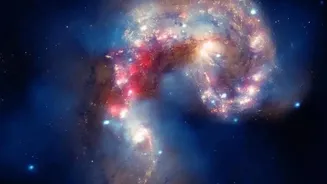
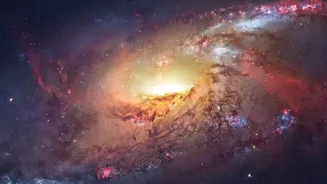
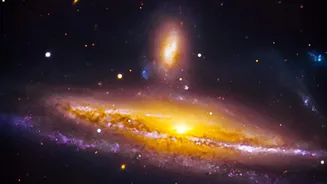
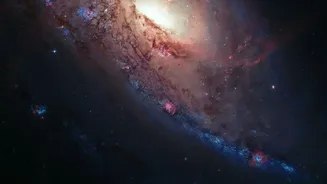
stars. While beautiful in many ways, this cosmic dust is a major headache for astronomers. It acts like a thick fog, absorbing and scattering visible light—the kind our eyes can see. This means that many fascinating regions, like the bustling centres of galaxies and the stellar nurseries where new stars are born, are completely hidden from traditional telescopes. The heart of our own Milky Way galaxy, for instance, is shrouded by so much dust that it's invisible to us in ordinary light.
Seeing in a Different Light
This is where infrared comes in. Infrared is a type of light, or electromagnetic radiation, that is invisible to our eyes but which we can sometimes feel as heat. Discovered in the 1800s by astronomer William Herschel, its wavelengths are longer than those of visible light. This simple physical difference is crucial. While shorter, tighter wavelengths of visible light are easily blocked or scattered by cosmic dust particles, the longer wavelengths of infrared light can pass right through. Think of how dense smoke from a fire can block your view, but a thermal camera can still see the heat of the flames and people through it. Infrared astronomy works on a similar principle, allowing astronomers to pierce the dusty veil and see what lies behind.
Our Infrared Eyes on the Sky
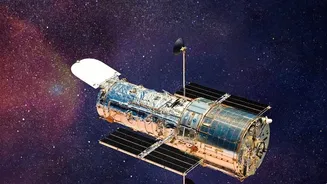
To capture this elusive light, astronomers use powerful space-based telescopes. While ground-based observatories can do some infrared work, Earth's atmosphere also blocks a lot of infrared radiation. By placing telescopes in space, we get a much clearer view. The recently launched James Webb Space Telescope (JWST) is the most powerful infrared observatory ever built, designed specifically to study the universe in these wavelengths. It joins a legacy of other vital infrared missions, like the Spitzer and Herschel space telescopes, which have already revolutionized our understanding of the cosmos. These telescopes use highly sensitive instruments to detect the faint heat signals from distant objects, translating them into the breathtaking images that reveal a hidden universe.
What We Uncover Through the Dust
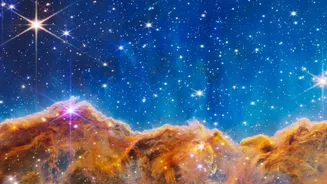
With infrared vision, we can witness cosmic processes that were once purely theoretical. One of the most exciting areas is the study of star formation. Stars are born deep inside dense clouds of gas and dust, regions completely opaque in visible light. Infrared telescopes can peer into these stellar nurseries, watching as collapsing clouds form protostars. This allows scientists to piece together the full story of how stars, including our own Sun, came to be. We can also study cooler, dimmer objects like brown dwarfs and exoplanets, which are too faint to be seen in visible light but glow in the infrared. Furthermore, by looking through the dust of our own galaxy, we can see the full, glorious structure of its starfields and even the intense activity around the supermassive black hole at its core.
A Window to the Early Universe
Perhaps most profoundly, infrared astronomy is a form of time travel. Because the universe is expanding, the light from the most distant objects gets stretched out as it travels across billions of years to reach us. Ultraviolet and visible light from the very first stars and galaxies is stretched so much that by the time it arrives at our telescopes, it is infrared light. This phenomenon, known as redshift, means that telescopes like JWST can see galaxies that formed just a few hundred million years after the Big Bang. By studying these ancient, dusty galaxies, we are beginning to understand how the complex universe we see today first came into being, charting the cosmic evolution of stardust, stars, and the galaxies they inhabit.